Children’s eye tests in Concord, from age 4
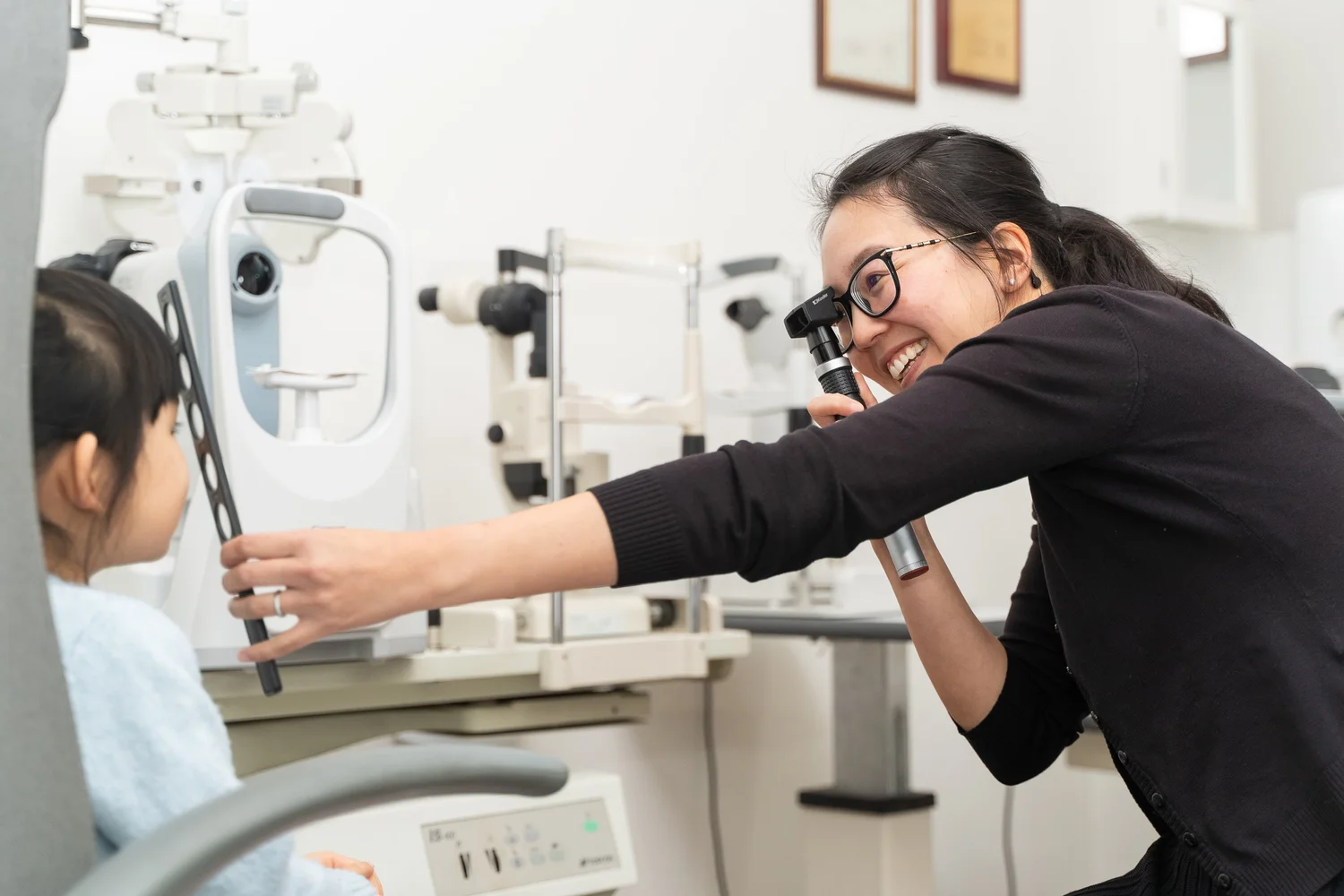
We test children from age 4 using equipment and techniques designed for kids. If something's wrong, we find it early. If everything's fine, you'll know for sure.
- ★ 4.9 from 200+ Google reviews
- Additional qualifications All of our optometrists hold additional qualifications to deliver a high standard of care
- All health funds HICAPS on the spot
Why Early Children’s Vision Testing Matters for Learning
Children's eyes aren't small adult eyes.
They need someone who knows the difference.
Most vision problems in children go undetected
Kids don't know what "normal" vision looks like. If they've always seen the world a certain way, they won't tell you something's wrong. To them, nothing is. That's why they can't just read a chart like an adult and get a meaningful result.
School screenings only catch a fraction of vision problems. They test distance vision. They don't assess how well your child's eyes work together, whether they can focus up close for reading, or whether there's an underlying condition developing.
A proper children's eye test looks at the whole picture. All three of our optometrists are trained in advanced paediatric eye care, and children's vision is a special interest for each of them.
- Dr Mark Joung · Advanced Paediatric Eye Care (UNSW)
- Dr Vivian Li · Advanced Children's Vision (ACO) · eye teaming
- Dr Nikki Peng · Advanced Children's Vision (ACO)
Signs to Watch For
You might not notice a problem. But these clues can help.
Children rarely complain about their vision. Instead, they show it through behaviour.
Avoids reading or close work
Loses interest quickly, skips words, or complains it's "boring" when it's physically uncomfortable.
Sitting too close to screens
Holding books very close, sitting right up against the TV, or leaning forward to see the whiteboard.
Headaches or tired eyes
Complains of headaches after school, rubs their eyes a lot, or seems unusually tired after homework.
Falling behind at school
Difficulty concentrating, reversing letters, or losing their place. Sometimes misdiagnosed as an attention issue.
Squinting or closing one eye
Closing one eye in bright light, tilting their head to focus, or actively suppressing one eye to see clearly.
Eyes that turn or don't align
One eye turning in or out, even briefly when tired. This needs an immediate assessment. It will not correct itself.
Clinical Disclaimer: This list of signs is an educational screening tool, not a diagnostic instrument. It does not replace a comprehensive medical eye examination. If your child is exhibiting any of these behaviors, a full functional assessment at Concord Eyecare is required to determine the underlying cause.
Clinical References: The behavioral indicators in this list are derived from the Evidence-Based Clinical Practice Guideline: Comprehensive Pediatric Eye and Vision Examination published by the American Optometric Association (AOA).
Want the full list of signs by age?
What’s Included in Our Comprehensive Children’s Eye Test?
A proper children's eye test goes well beyond the chart
School screenings check one thing: distance vision. We check more than eight. Here's what a comprehensive assessment covers.
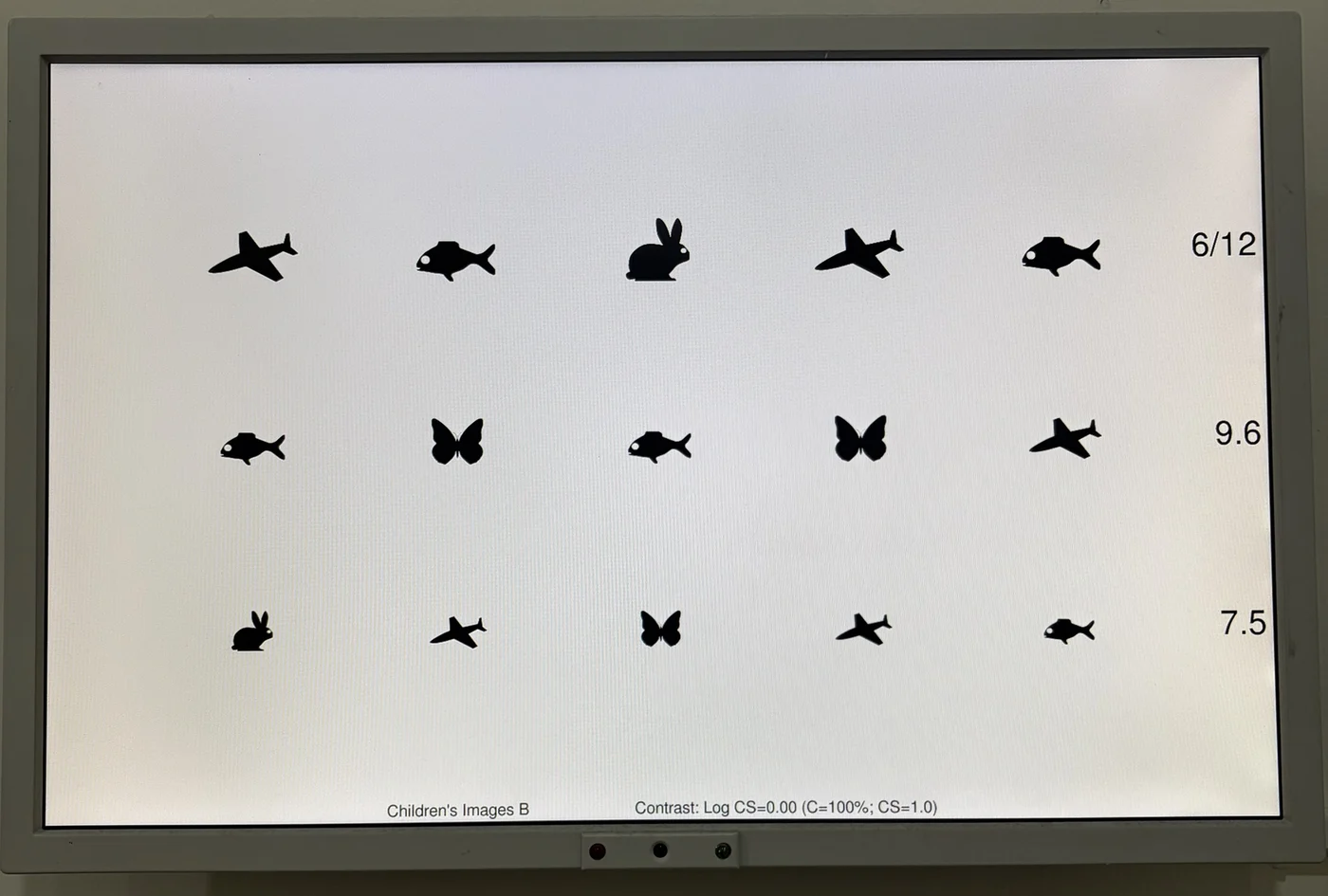
Distance & near vision
How clearly your child sees at range and up close. We use age-appropriate tests as well as a letter chart.
Focusing ability
Can their eyes shift focus smoothly between near and far? This is critical for classroom learning: board to book and back.
Eye teaming & alignment
Do both eyes work together as a pair? Misalignment or poor coordination causes double vision, headaches, and reading difficulty.
Eye tracking
Can their eyes follow a moving target smoothly? Poor tracking makes reading exhausting: they lose their place, skip lines, re-read.
Colour vision
About 8% of boys have some form of colour vision deficiency. We test for it. Schools don't check it, and it affects learning.
Prescription check
Using objective measurement (retinoscopy). We don't rely on your child's answers to determine if they need glasses.
Eye health
Checking the front and back of the eye for any structural or health concerns. That includes early signs of conditions that develop in childhood.
Myopia risk assessment
If your child is short-sighted or at risk, we measure how fast the eyes are changing and discuss whether myopia control is appropriate. If they are not short-sighted yet, we can measure how much hyperopic reserve they still have.
Ready to book your child's eye test?
A Stress-Free Guide to Your Child’s First Eye Test
What to expect, so you and your child feel prepared
No surprises. Here's how the visit works from start to finish.
Allow 30–40 minutes
We take our time. No rushing. If your child needs a break, that's fine.
Kid-friendly tests
We use pictures, shapes, and games as well as letters. Designed for kids who can't read yet.
Parent stays throughout
You're in the room the whole time. We explain what we're testing and why as we go.
Plain-language results
No jargon. We'll explain exactly what we found, what it means, and what (if anything) needs to happen next.
Eye Teaming Assessment and Vision Therapy
When the eyes are healthy but vision still isn't working
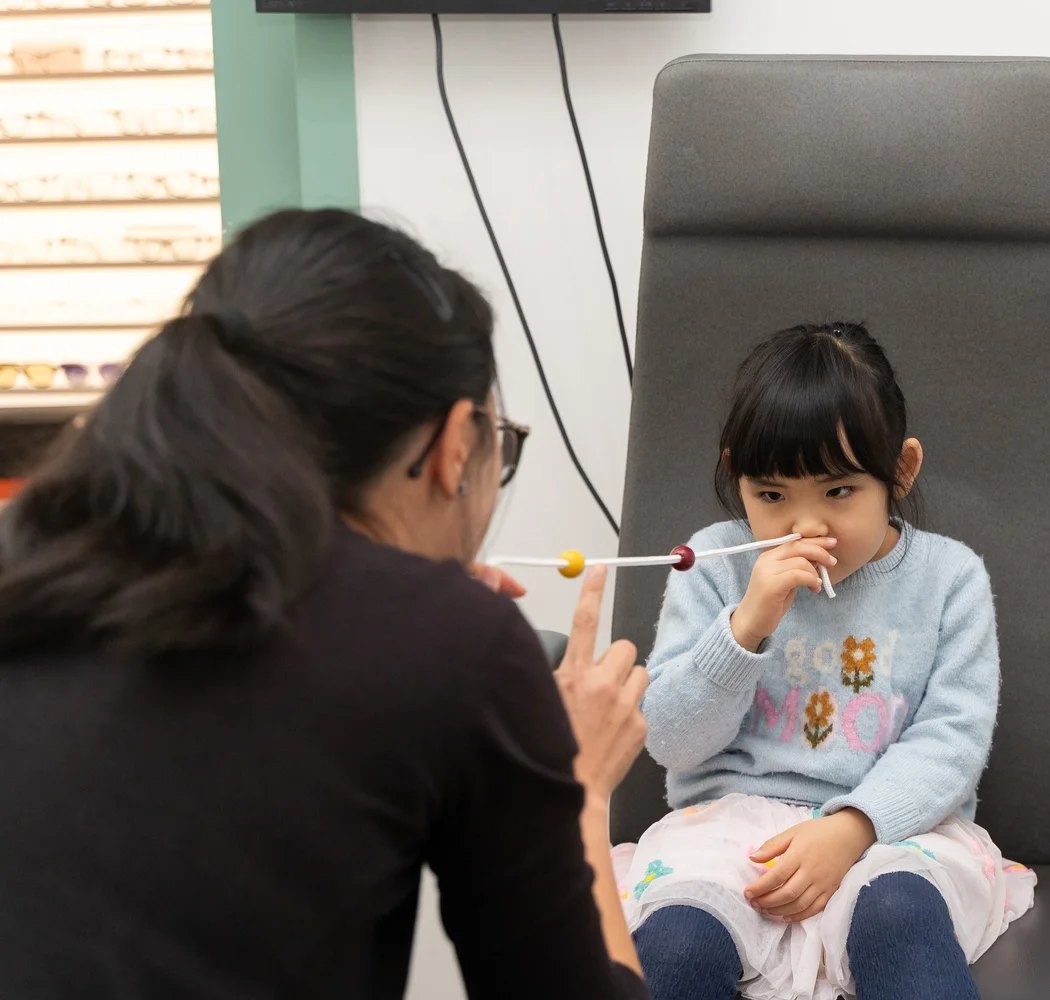
Sometimes a child's eyes are perfectly healthy and their prescription is fine. But they still struggle with reading, concentration, or coordination. That's often a functional vision problem: the eyes aren't working together as a team.
Dr Vivian Li: children's vision, eye teaming & functional vision
Vivian tests how your child's eyes track, focus, and coordinate. These are skills that don't show up in a standard eye test but are critical for learning. If a functional issue is found, she can develop a vision training program tailored to your child: in-practice sessions designed to strengthen the visual skills your child needs for reading, writing, and classroom performance.
- B.Optom (Hons)
- Advanced Children's Vision (ACO)
- Children's vision and eye teaming
Recommended Ages for Children’s Eye Tests
How often should your child have an eye test?
Children's eye tests are currently bulk billed for eligible Medicare card holders aged 4 and over.
Age 4 · First eye test
Before they start school. Catches issues early, when we have the most options to support vision development.
Age 6–7 · Start of primary school
Vision demands increase dramatically. This is when short-sightedness often begins. Annual tests recommended.
Age 8–12 · Every year
The years when myopia usually gets worse fastest. Also when eye-teaming and tracking issues start affecting school performance.
Age 13+ · Annually or as needed
Screen time increases, prescription may change rapidly. Contact lens fitting becomes an option.
Is your child's eyesight getting worse every year?
If your child's short-sightedness is getting worse, we run a dedicated clinic for that. Treatment options, pricing, and how it all works are on the dedicated site.
1,000+ Ortho-K lenses fitted by our optometrists, between them
The 1,000+ figure comes from our optometrists' practice records across their careers (October 2026).
North Strathfield Children's Optometrist FAQs
Children's eye care: your questions answered
Are children's eye tests bulk billed?
Yes. Children's comprehensive eye tests are currently bulk billed for eligible Medicare card holders aged 4 and over. Children can be tested regularly: Medicare covers a comprehensive eye exam every 3 years, and sooner when there is a clinical reason.
What age should my child first have an eye test?
We recommend a first eye test at age 4, before starting school. Testing early means we can identify vision concerns when we have the most options to support your child's learning and development.
How do I know if my child needs glasses?
Common signs include sitting too close to the TV or screen, squinting at the board from the back of the class, rubbing eyes often, complaining of headaches or tired eyes, tilting the head to read, or losing their place while reading. Some signs are age-specific. Preschoolers, primary schoolers and teenagers can each show different patterns. Read the Parent's Guide
My child passed their school screening. Do they still need a test?
School screenings only check distance vision. They don't assess focusing, eye teaming, tracking, colour vision, or eye health. Passing a screening doesn't mean everything's fine. It means one thing was checked.
My child can't read letters yet. Can you still test them?
Absolutely. We use picture charts, shapes, and objective tests that don't rely on your child's answers at all. We test children from age 4, including non-verbal children.
What if my child needs glasses?
We'll explain exactly what the prescription means and help your child choose frames they like wearing. We stock a wide range of durable, comfortable children's frames, including options designed for active kids.
My child's eyesight keeps getting worse. Can you help?
Yes. That's one of our special interests. We run a dedicated clinic for it. Visit The Myopia Clinic
Can vision problems cause learning difficulties?
Yes, and they're more common than most people think. Problems with focusing, eye tracking, or eye teaming can look like attention issues or learning difficulties. A proper eye test can identify these so we can help.
Do you do vision therapy?
Yes. Our optometrist Dr Vivian Li has a special interest in children's vision and eye teaming and offers vision training programs for children whose eyes aren't working together properly. These are tailored, in-practice sessions that strengthen the visual skills needed for reading and learning.

Medically Reviewed by Dr. Mark Joung B.Optom (Hons) UNSW, Certificate in Ocular Therapeutics (ACO) | Updated March 2026
References (11)
- Hopkins S, et al. "Undetected eye problems in children — impact on literacy and behaviour." Clin Exp Optom. 2019;102(6):570-579. doi:10.1111/cxo.12898
- Scheiman M, Wick B. Clinical Management of Binocular Vision: Heterophoric, Accommodative, and Eye Movement Disorders. 5th ed. Wolters Kluwer; 2020.
- Holmes JM, Clarke MP. "Amblyopia." The Lancet. 2006;367(9519):1343-1351. doi:10.1016/S0140-6736(06)68581-4
- Kulp MT, et al. "Prevalence of vision disorders in children with reading disability." Journal of AAPOS. 2016;20(6):e24. doi:10.1016/j.jaapos.2016.07.081
- Holden BA, et al. "Global prevalence of myopia and high myopia and temporal trends from 2000 through 2050." Ophthalmology. 2016;123(5):1036-1042. doi:10.1016/j.ophtha.2016.01.006
- Granet DB, et al. "The relationship between convergence insufficiency and ADHD." Strabismus. 2005;13(4):163-168. doi:10.1080/09273970500455436
- RANZCO / Optometry Australia. "Position Statement: Children's Vision." 2020.
- Cotter SA, et al. "Treatment of strabismic amblyopia with refractive correction." Am J Ophthalmol. 2007;143(6):1060-1063.
- Goldstand S, Koslowe KC, Parush S. "Vision, visual-information processing, and academic performance among seventh-grade schoolchildren." Am J Occup Ther. 2005;59(4):377-389.
- Flitcroft DI, et al. "IMI – Defining and Classifying Myopia: A Proposed Set of Standards for Clinical and Epidemiological Studies." Invest Ophthalmol Vis Sci. 2019;60(3):M20–M30. doi:10.1167/iovs.18-25957
- Birch J. "Worldwide prevalence of red-green color deficiency." J Opt Soc Am A. 2012;29(3):313-320. doi:10.1364/JOSAA.29.000313
The best time to check is before there’s a problem.
30–40 minutes. Medicare bulk billed. All three optometrists are trained in advanced paediatric eye care.