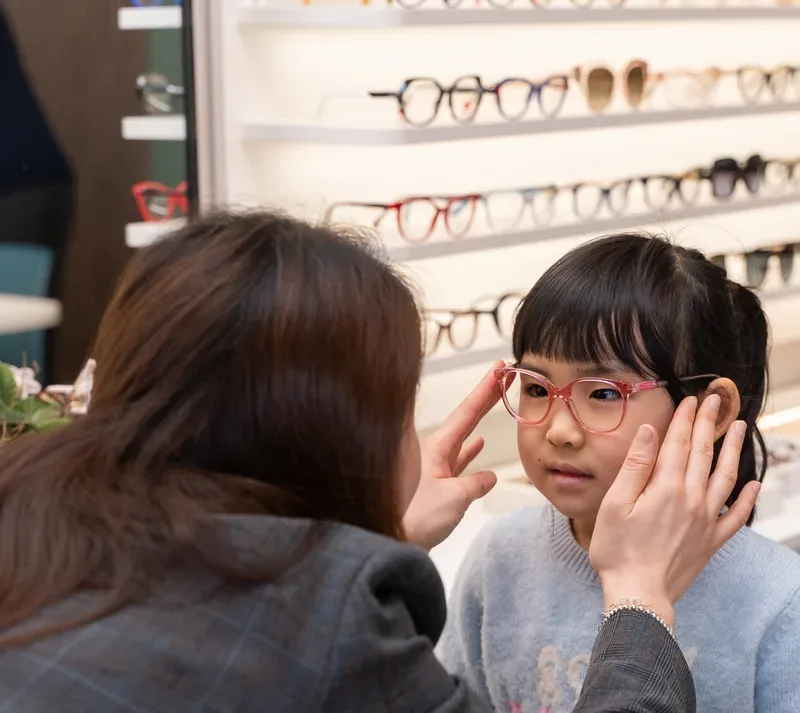
Signs your child might need glasses and what to do about it.
Signs Your Child Needs Glasses: A Parent’s Guide
Many kids don't know what "normal" vision looks like. So they won't tell you something's wrong. Here's what to watch for, when to act, and why a school screening isn't enough.
- ★ 4.9 from 200+ Google reviews
- Advanced qualifications in children's vision All of our optometrists hold advanced qualifications in children's vision
- 2,500+ children cared for by our optometrists
- 1,000+ ortho-K lenses fitted between our optometrists
Signs your child needs glasses, by age
What to watch for by age
Different ages show different signs. Here's what's relevant for your child.
Age 3–5
Preschool & kindy
Sitting very close to the TV or holding books right up to their face. Squinting or closing one eye. Clumsy or bumping into things on one side. An eye that turns in or out (even briefly). Lack of interest in puzzles, colouring, or detail-oriented activities. These kids often get labelled "not interested" when they can't see the detail.
Age 6–10
Primary school
Losing their place when reading or using a finger to track lines. Avoiding reading or saying it's "boring" when it's uncomfortable. Difficulty copying from the whiteboard. Messy handwriting that doesn't match their ability. Confusing similar-looking letters like b and d. Headaches after school, especially around the forehead. Rubbing eyes a lot during homework.
Age 11+
High school
Squinting to see the board or screen from the back of the classroom. Holding their phone very close. Complaining of tired eyes or headaches after screen time. Declining interest in sport (especially ball sports, where distance judgement matters). One eye closing in bright sunlight. These signs often get dismissed as "just being a teenager" or screen fatigue.
Don't feel guilty if you've missed the signs. These are easy to miss because children adapt and compensate. They don't know anything is wrong, so they don't act like it. The fact that you're reading this page means you're paying attention. That's what matters.
Why kids don’t tell you they cant see properly
Your child probably won't say "I can't see."
Here's the thing most parents don't realise: if your child has always seen the world a certain way, they have no reason to think something's wrong. Blurry writing on a whiteboard? That's just how whiteboards look. Words that swim on a page? That's just what reading is. Headaches after school? That's just tiredness.
Children adapt. They compensate. They sit closer, squint harder, avoid the things that are difficult. And because they don't have a frame of reference for "normal" vision, they don't complain. They struggle and say nothing.
That's why you can't wait for your child to tell you there's a problem. You have to know what to look for.
When the problem isn't glasses. It's how the eyes work together
Sometimes the eyes are fine but they don't work together.
Not every vision problem is solved with glasses. Some children have healthy eyes and a normal prescription. But their eyes don't coordinate properly. They can't track smoothly across a line of text. They can't shift focus from the board to their book and back. Their eyes don't work as a team, so reading is exhausting and concentration suffers.
These are called functional vision problems, and they don't show up on a letter chart. They often get misdiagnosed as ADHD, dyslexia, or a learning difficulty. The symptoms overlap. A proper children's eye test checks for these specifically.
In our practice, we see kids every week whose "learning problem" turns out to be a vision problem. It's one of the most rewarding things we do. Once you know, you can fix it.
School vision screening vs a proper eye test
Why "passed the school screening" doesn't mean everything's fine.
School vision screenings check one thing — whether your child can read letters at a distance. That's it. They don't check whether your child can focus up close for reading. They don't check whether both eyes are working together. They don't check eye tracking, colour vision, or eye health.
School vision screenings check one thing — whether your child can read letters at a distance. That's it. They don't check whether your child can focus up close for reading. They don't check whether both eyes are working together. They don't check eye tracking, colour vision, or eye health.
In our practice, we see kids every week who've passed their school screening but have a significant issue we pick up in the first five minutes of a proper test.
School Screening
- Distance vision only
- One-size-fits-all letter chart
- No focusing assessment
- No eye teaming check
- No eye health examination
- No colour vision testing
- Pass/fail: no detail
Comprehensive Eye Test
- Distance and near vision
- Age-appropriate tests
- Focusing ability and flexibility
- Eye teaming and alignment
- Eye tracking assessment
- Colour vision
- Full eye health check
- Myopia risk assessment
```
When should you book your child's first eye test?
When should your child have their first eye test?
We recommend a first comprehensive eye test at age 4, before starting school. Medicare covers this at no cost. This catches problems early, when they're easiest to correct and before they start affecting learning.
After that, annual eye tests are the safest approach. This matters most from age 6 onwards, when vision demands increase dramatically and myopia commonly begins. If there's a family history of glasses, lazy eye, or eye conditions, annual tests are particularly important.
Don't wait for a problem to appear. Many vision issues have no obvious symptoms: your child won't squint, won't complain, and won't fail a school screening. The only way to know for sure is a proper test.
When to book an urgent test
Book sooner rather than later if you notice: one eye turning in or out (even occasionally), a white reflection in your child's pupil in photos, sudden loss of interest in reading or close activities, complaints of double vision, or a noticeable head tilt when concentrating. These may indicate something that needs prompt attention.
What happens if a child needs glasses but doesn't get them
What happens if a vision problem goes untreated?
Vision is a skill that develops through childhood. Some problems have a window where treatment works best. Amblyopia (lazy eye) is a good example: it's very treatable in young children, but becomes much harder to correct after age 7–8. The earlier you catch it, the better the outcome.
Uncorrected vision problems affect more than sight. Kids who can't see the board clearly often get mislabelled as disruptive, distracted, or "not trying." Reading difficulties can spiral into avoidance, low confidence, and falling behind academically. This isn't because they're not capable, but because their eyes aren't giving them the tools they need.
And if your child is developing myopia (short-sightedness), how early it starts matters. Myopia that starts young and gets worse quickly increases the risk of serious eye conditions later in life, including retinal detachment, glaucoma, and macular degeneration. This is where myopia control comes in: treatments that slow how fast the eye grows. We explain the options, and when to start, at a myopia assessment.
What a children's eye test involves
What happens when you bring your child in?
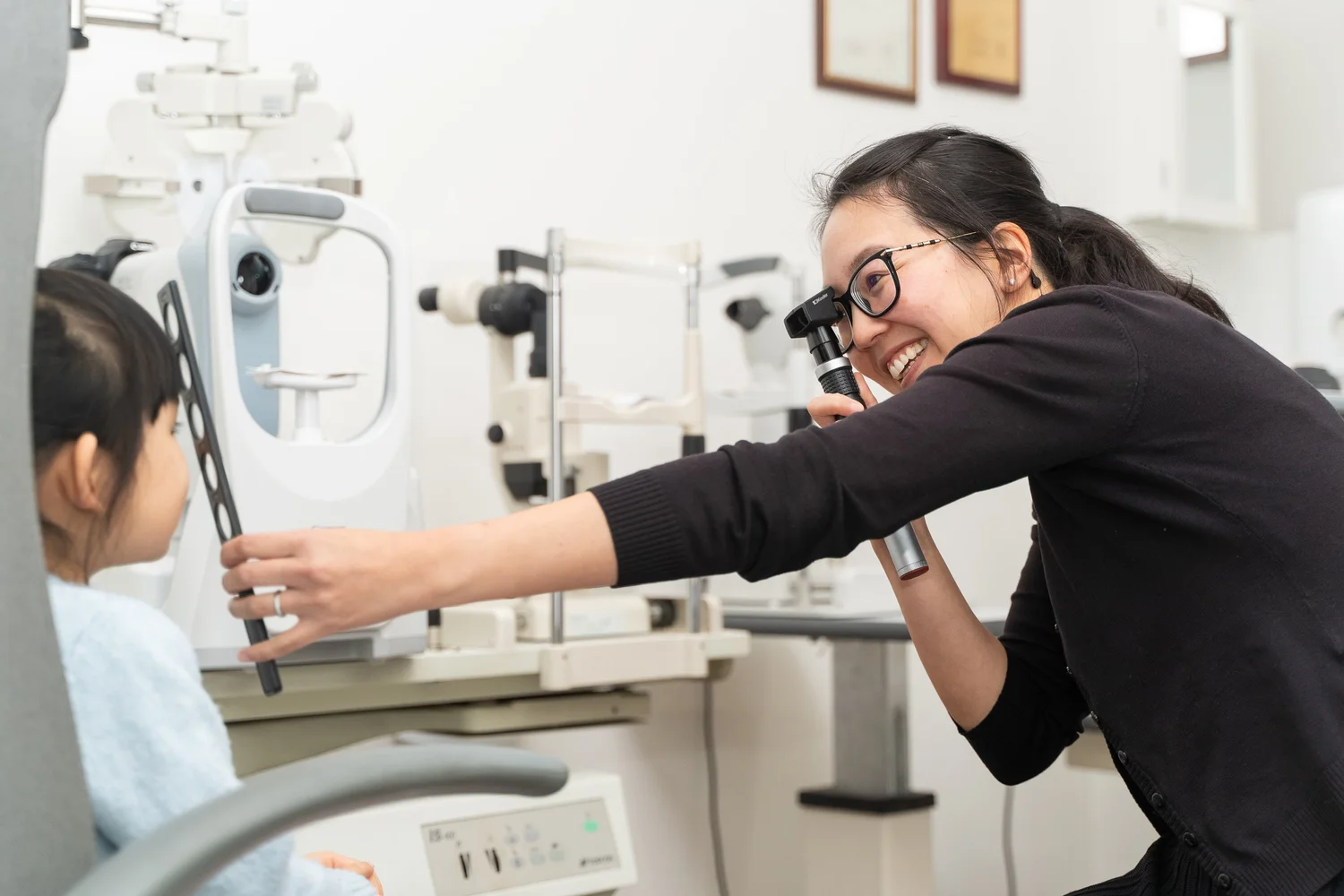
A children's eye test at our practice takes about 30–40 minutes. We use child-friendly equipment and techniques: picture charts, shapes, and games instead of letters. Your child doesn't need to know how to read.
We check eight things that a school screening doesn't: distance and near vision, focusing ability, eye teaming and alignment, eye tracking, colour vision, prescription (using objective measurement, not your child's answers), eye health, and myopia risk.
You stay in the room the whole time. We explain what we're testing and what we find as we go. No jargon, no surprises. All three of our optometrists have advanced paediatric training, and Dr Vivian Li has a special interest in children's vision and eye teaming (how the two eyes work together).
Children's eye tests are bulk billed through Medicare for all Australians aged 4 and over.

Dr Mark Joung
· Advanced Paediatric Eye Care (UNSW)
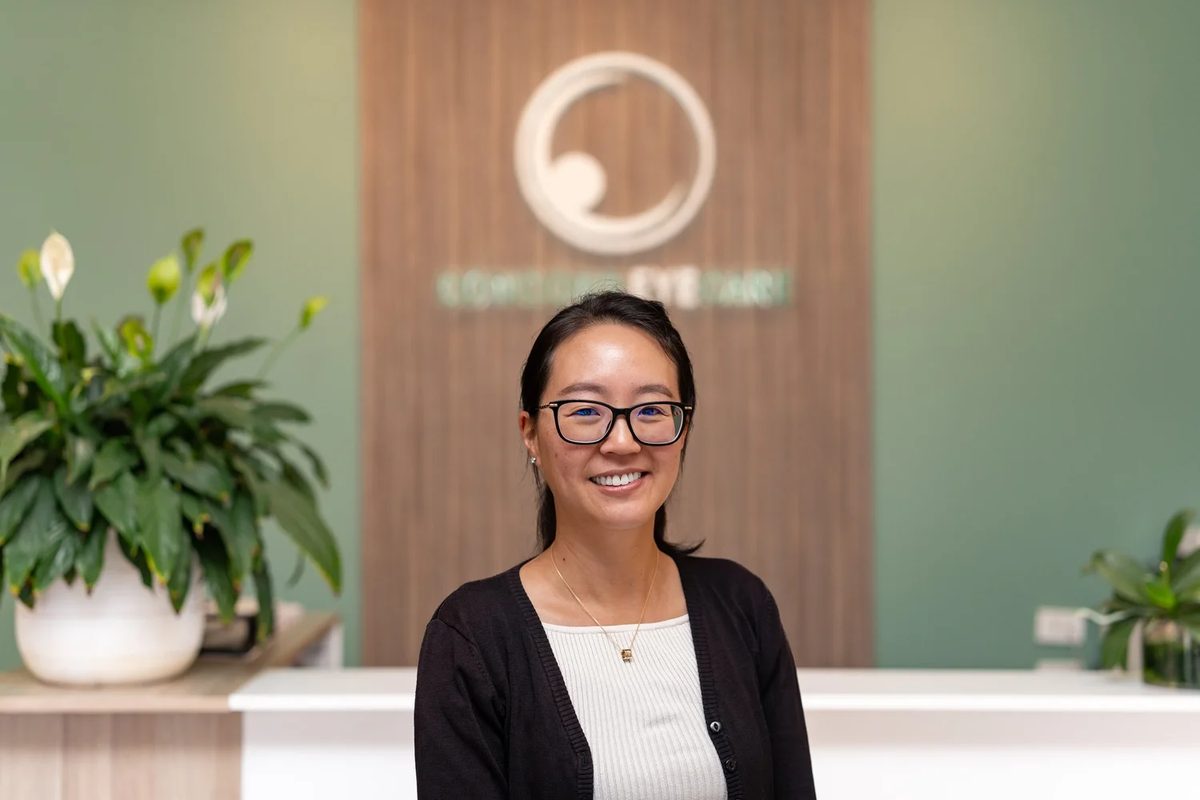
Dr Vivian Li
· Advanced Children's Vision (ACO) · Children's vision and eye teaming
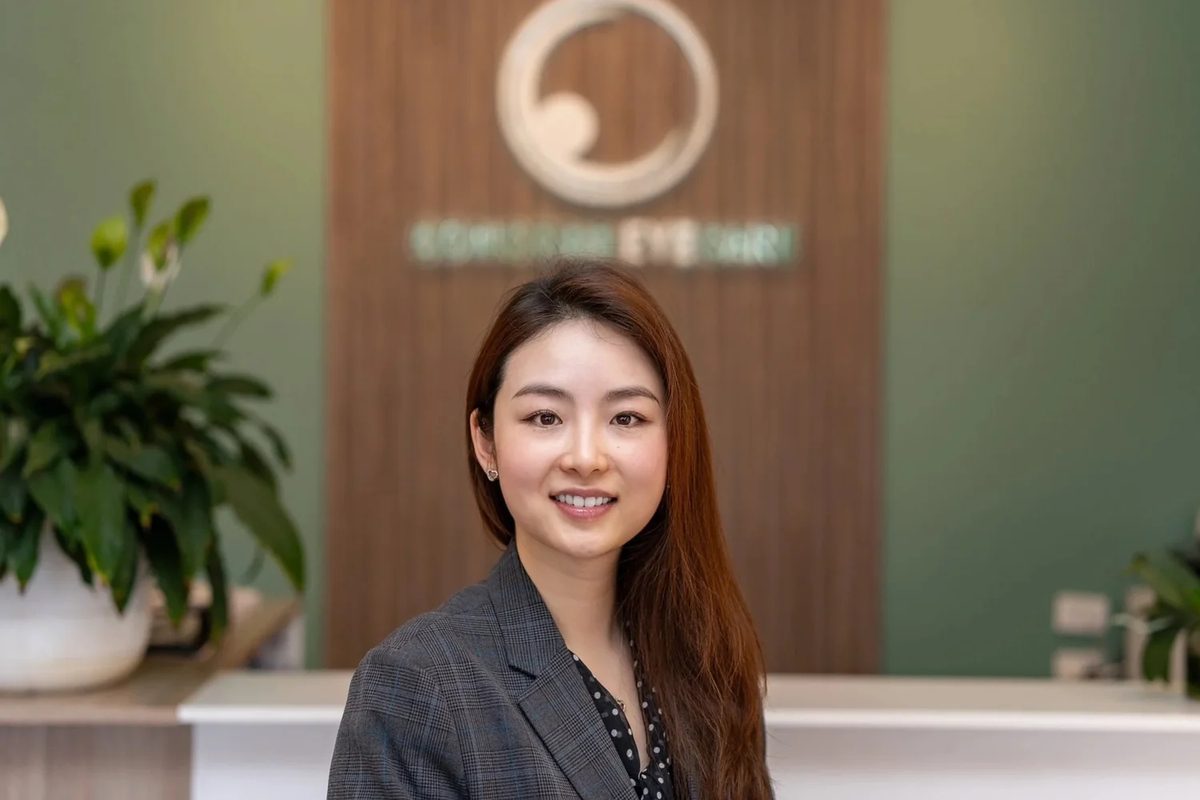
Dr Nikki Peng
· Advanced Children's Vision (ACO) · Brien Holden Vision Institute
What parents need to know before booking
Three things to keep in mind.
Every child is different. Some signs may be normal developmental behaviour, not a vision problem. An eye test is the only way to know for sure. There's no harm in checking.
One test doesn't mean your child is set for life. Vision changes, especially during school years. Annual checks are the safest approach. It's covered by Medicare, takes 30 minutes, and gives you peace of mind.
If we find something, we'll explain it clearly. No pressure, no jargon. We'll walk you through what it means, what the options are, and what we'd recommend. You make the decision.
Frequently Asked questions about children’s glasses
Children’s vision - your questions answered
Are children's eye tests bulk billed in Australia?
Yes. Medicare covers eye tests for all Australians aged 4 and over. Your child can be tested every year with no out-of-pocket cost.
Can a child need glasses even if neither parent wears them?
Yes. While genetics play a role, vision problems can develop independently. Environmental factors like screen time and limited outdoor activity also contribute, especially to myopia.
What's the difference between a school screening and a proper eye test?
A school screening only checks distance vision. A comprehensive eye test also assesses focusing, eye teaming, tracking, colour vision, eye health, and binocular vision. We regularly see children who passed their school screening but have significant issues.
At what age should my child first see an optometrist?
We recommend a first comprehensive children's eye test at age 4, before starting school. Medicare covers this at no cost. If you notice signs earlier, we can test younger children too.
My child's eyesight keeps getting worse every year. Is that normal?
Short-sightedness that keeps increasing is common in children, but shouldn't be ignored. It raises the risk of eye disease later in life. We run the Concord Myopia Clinic, with treatments that slow how fast the eye grows. Visit concordmyopiaclinic.com.au
Can vision problems be mistaken for ADHD or learning difficulties?
Yes. It happens more often than most people think. Functional vision problems can cause difficulty concentrating, fidgeting, and avoiding reading. These symptoms overlap with ADHD and learning difficulties. A proper eye test can rule this out.


Medically Reviewed by Dr. Mark Joung B.Optom (Hons) UNSW, Certificate in Ocular Therapeutics (ACO) | Updated March 2026
The 2,500+ and 1,000+ figures come from our optometrists' practice records across their careers (October 2026).
References (10)
- Scheiman M, Wick B. Clinical Management of Binocular Vision: Heterophoric, Accommodative, and Eye Movement Disorders. 5th ed. Wolters Kluwer; 2020.
- Kulp MT, et al. "Prevalence of vision disorders in children with reading disability." Journal of AAPOS. 2016;20(6):e24. doi:10.1016/j.jaapos.2016.07.081
- Goldstand S, Koslowe KC, Parush S. "Vision, visual-information processing, and academic performance among seventh-grade schoolchildren." Am J Occup Ther. 2005;59(4):377-389.
- Hopkins S, et al. "Undetected eye problems in children — impact on literacy and behaviour." Clin Exp Optom. 2019;102(6):570-579. doi:10.1111/cxo.12898
- Flitcroft DI, et al. "IMI — Defining and classifying myopia: A proposed set of standards." Invest Ophthalmol Vis Sci. 2019;60(3):M68-M88. doi:10.1167/iovs.18-25957
- Holmes JM, Clarke MP. "Amblyopia." The Lancet. 2006;367(9519):1343-1351. doi:10.1016/S0140-6736(06)68581-4
- Cotter SA, et al. "Treatment of strabismic amblyopia with refractive correction." Am J Ophthalmol. 2007;143(6):1060-1063.
- Optometry Australia. "Clinical Practice Guide for the Examination of the Paediatric Patient." 2020.
- Holden BA, et al. "Global prevalence of myopia and high myopia and temporal trends from 2000 through 2050." Ophthalmology. 2016;123(5):1036-1042. doi:10.1016/j.ophtha.2016.01.006
- Granet DB, et al. "The relationship between convergence insufficiency and ADHD." Strabismus. 2005;13(4):163-168. doi:10.1080/09273970500455436
It’s 30 minutes, and it give you peace of mind.
All three optometrists have advanced paediatric training. We test children from age 4.