Myopia Clinic · North Strathfield Sydney
Evidence-based myopia control for your child.
Is your child’s myopia getting worse? Measuring axial length is the accurate way to find out, and you leave with a written plan.
$95Children's Myopia Assessment, 45 minutes to an hour

- ★ 4.9 from 200+ Google reviews
- Advanced qualifications in children's vision All of our optometrists hold advanced qualifications in children's vision
- 2,500+ children cared for by our optometrists
- 1,000+ ortho-K lenses fitted between our optometrists
Start here
What parents ask first
Your child's eyes got worse again this year, even after cutting back screens and getting them outside. You just want to do the right thing for your child.
Pick the question closest to yours.
Which treatment suits my child's age?
Compare the lens options and their usual starting ages.How will we know it's working?
We usually measure axial length every six months and plot it on your child's own growth chart.Is it safe, and what if we stop?
Start with our ortho-K safety guide. Each treatment page covers its own risks and what happens if you stop.What does it cost?
The assessment is $95. We explain treatment costs at that visit, before anything starts.Still learning about myopia itself? Start with our guide to what myopia is and why it matters.
Why it matters
What it means when your child's eyes keep getting worse
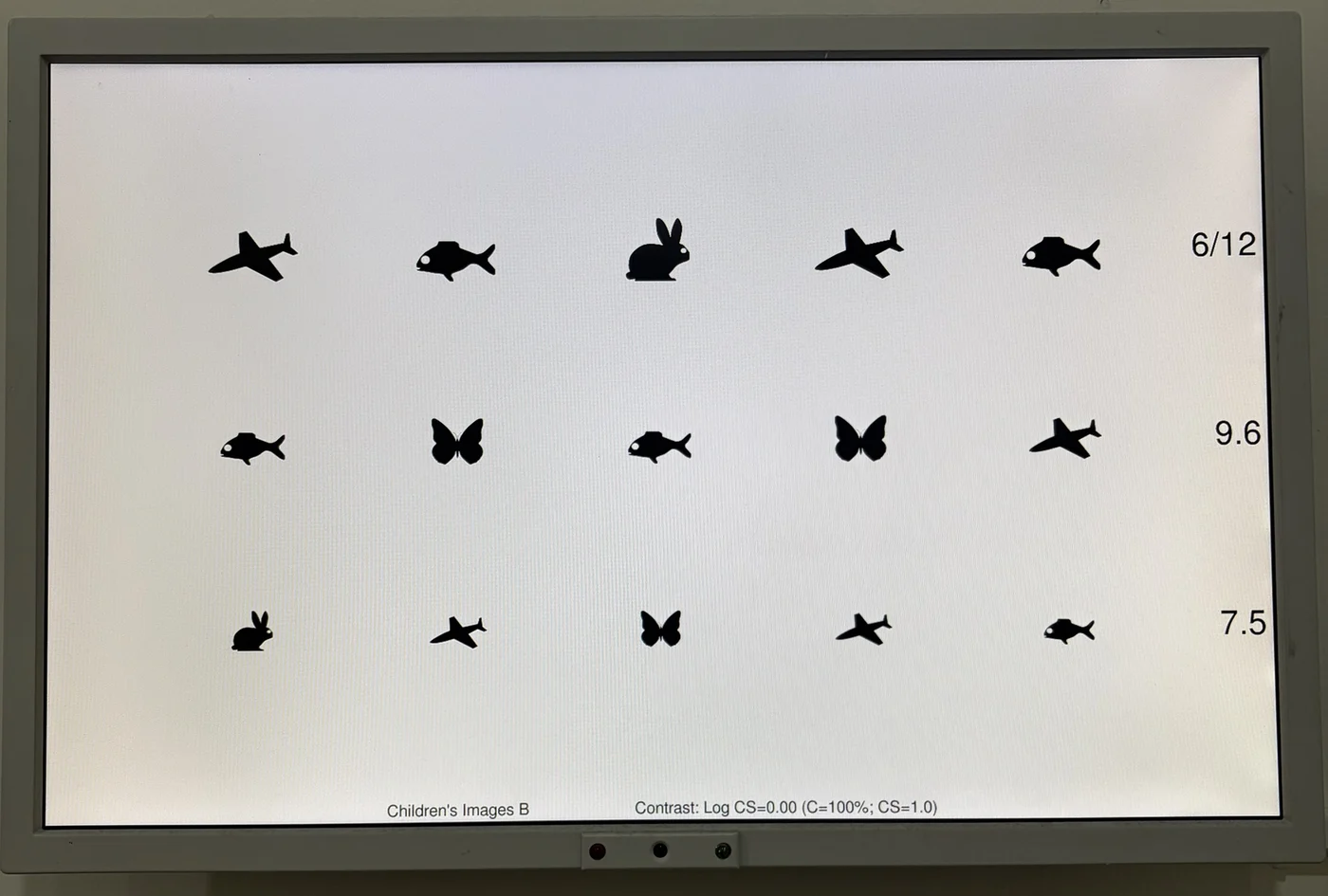
Without glasses
What your child sees
Short-sightedness gets worse when the eye grows too long. The studies show it usually changes fastest in younger children and slows through the teenage years (Brennan et al., 2021).
It matters because a higher prescription in adult life is linked with a higher risk of eye conditions later on. In the researchers’ words, every dioptre counts (Bullimore and Brennan, 2019).
How fast a child's eyes get worse varies significantly with genetics, ethnicity, family history, axial length, and lifestyle. A clinical consultation, including axial length measurement, refraction and corneal topography, is what gives a real answer for your child.
Read more about why myopia keeps getting worse and when to start treatment.
How far it goes
How much can short-sightedness change before it stops?
In a long US study, children's eyes kept getting worse for years after their first glasses.
COMET: US children in ordinary or progressive glasses, followed until myopia stopped changing
−4.87 D
The average prescription by the time their myopia stopped changing.
A group average from children without myopia control, not a forecast for one child.
COMET Group 2013, Invest Ophthalmol Vis Sci
Treatment matcher
Which option should we talk about for my child?
Start from your child's age and daily life. The assessment confirms what suits them.
If your child
Is 4 or 5
Myopia control glasses come first. Contact lens options start from about 6.
If your child
Plays a lot of sport
Ortho-K is worn overnight, so there is nothing to wear during the day.
If your child
Might lose glasses
Ortho-K or MiSight daily contacts leave nothing to forget at school.
If your child
Is wary of contact lenses
Myopia control glasses such as MiyoSmart iQ or Stellest 2.0.
If your child
Has a higher prescription
Contact lenses often suit better than thicker spectacle lenses.
If your child
Has eyes changing quickly
We may combine two treatments, sometimes with prescribed low-dose atropine.
A starting point for the conversation, from the age guides on when to start myopia control.
How we manage childhood myopia
The SightTrack™ Myopia Program: a growth chart for your child's eyes
SightTrack is our own way of tracking a child's myopia: the same measurements at every visit, plotted on one growth chart, so you can see whether treatment is working. Four steps, repeated at every review, built around one number: how fast your child's eye is growing.
1. Measure
Measure axial length and prescription
2. Match
Recommend options for your child
3. Track
Measure axial length at each review
4. Adjust
Review the plan if growth stays fast
Each review adds a dot. If the dots climb faster than the curves, we step up treatment.
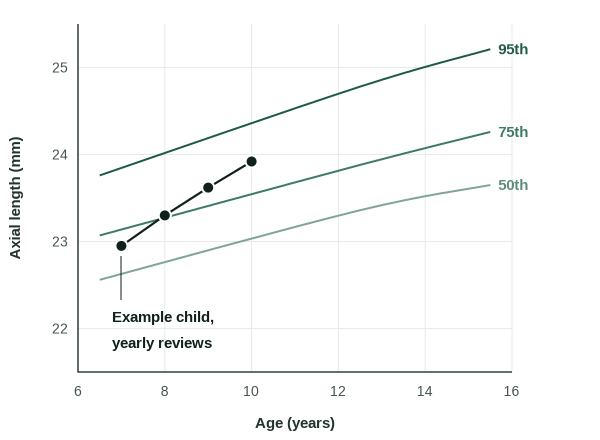
Figure. Axial length centiles (50th, 75th, 95th) for white European children aged 6 to 16, from the Northern Ireland Childhood Errors of Refraction (NICER) study: published values at ages 6-7, 12-13 and 15-16 (McCullough et al., 2020, Table 4), joined by smooth curves. The example child is illustrative, not a real patient or a treatment result.
Book a Myopia Assessment or call 02 8765 9600
The four steps in detail
SightTrack™ is how we manage childhood myopia at Concord Eyecare in North Strathfield. Every child follows the same four steps (Measure, Match, Track, Adjust), built around the number that matters most: how fast the eye is growing. The same way your GP tracks height and weight, applied to your child's eyes.
No two children's eyes get worse at the same rate. The steps stay the same while the treatment fits your child. Whatever pathway your child starts on, the plan is reviewed against their own growth chart, and you'll always know where they stand.
1. Measure
- Comprehensive myopia assessment before any treatment decision
- Axial length measured, to see how the eye itself is growing
- Not short-sighted yet? We measure how much hyperopic reserve is left
- Family history, habits and screen time factored in
2. Match
- Three lens options (ortho-K night lenses, myopia-control glasses and myopia-control contact lenses), with prescription eye drops discussed where relevant
- Matched to your child's age, prescription and lifestyle
- Fees for each pathway explained up front at your assessment
3. Track
- Growth plotted against age norms, so you can see the chart for yourself
- Fast growth shows up early, so treatment can be adjusted sooner
- Every review adds a point to your child's own growth curve
4. Adjust
- If the eye is still growing too fast, treatment is stepped up or switched
- Measurements carry over, so changing pathways is straightforward
- Your child's growth chart is shared across our optometrists, so whoever you see has the full picture
What you take home
A measurement, a plan, a review
Your child's growth chart and written plan, from the first visit to every review.
SightTrack™
Myopia Growth Report · a growth chart for your child's eyes
Concord Eyecare
The Myopia Clinic · North Strathfield
SAMPLE REPORT · ILLUSTRATIVE DATA
Sample patient · Age 9.0 · Right eye · 4 reviews since age 7.5 · reviewed 6-monthly
This child: on track
- On track Growing at a typical pace for age, on the same curve.
- Watch Growing faster than the curve. We recheck sooner and look at wear and fit.
- Act Climbing across the bands. We step treatment up or switch.
Axial length against age norms
Each dot is one review. The shaded bands show where most children of each age sit.
- This child (sample)
- Illustrative example: excessive growth, 0.3–0.4 mm a year
- Typical range (25th–75th)
- Above average (75th–95th)
- Fast for age (above 95th)
Axial length
23.42 mm
Right eye, at age 9.0
Percentile
~60th
Steady since baseline
Growth this year
0.17 mm
Sample figure
Status
On track
Green: following the same curve
Arm chosen
Overnight lens (ortho-K)
Next review
In 6 months
Red line example: growth a year
0.3–0.4 mm
The red dashed line (illustrative)
Red line example: status
Act
Excessive, now at the 85th percentile
What the two lines show
The solid line is growing at a typical pace for its age and staying on the same curve. The red dashed line is an illustrative example of excessive growth, 0.3 to 0.4 mm a year, climbing across the bands to the 85th percentile. That is the pattern the six-monthly measurement is there to catch early, so treatment can be reviewed.
Reference curves: Ulster / NICER axial-length growth charts (McCullough et al., Scientific Reports 2020)
Measured with the ZEISS IOLMaster 500 · re-checked every 6 months
The number behind every decision
The gold standard for tracking myopia
The International Myopia Institute recommends axial length (the length of the eye) as the gold standard for monitoring myopia.
Axial length is the length of your child's eye from front to back. Myopia gets worse as the eye grows longer, so this one number shows how fast it is changing.
SightTrack runs on axial length: a precise measurement of the eye's length taken at every review. How axial length works · the full explainer
The scan is included in the $95 Children's Myopia Assessment and in ortho-K. The $45 is for a progress scan on its own, every six months, for children wearing MiyoSmart or Stellest glasses. For children whose treatment is prescribed eye drops, SightTrack monitoring is $120 a year, covering axial length checks every 6 months, a progress review and the SightTrack report.
Source: International Myopia Institute (Wolffsohn et al., 2019).
Lens options
Three lens options, under one roof
The right treatment depends on your child's age, lifestyle, and how fast their prescription is changing. The studies show most of these slow myopia by at least half (lens trials: Lam et al., 2020; Chamberlain et al., 2019; Cho and Cheung, 2012). We'll walk through every option at your consultation.
By age, in short: from around 4 or 5 we can start measuring axial length; from about 4, MiyoSmart glasses; from about 6, ortho-K or MiSight daily contacts as well. Most children start treatment between 6 and 10, and teenagers are welcome.

Ortho-K (overnight lenses) · Ages 6+
Rigid contact lenses worn only at night. Your child wakes up with clear vision. No glasses or daytime contacts needed.
From $1,600
Learn about Ortho-K
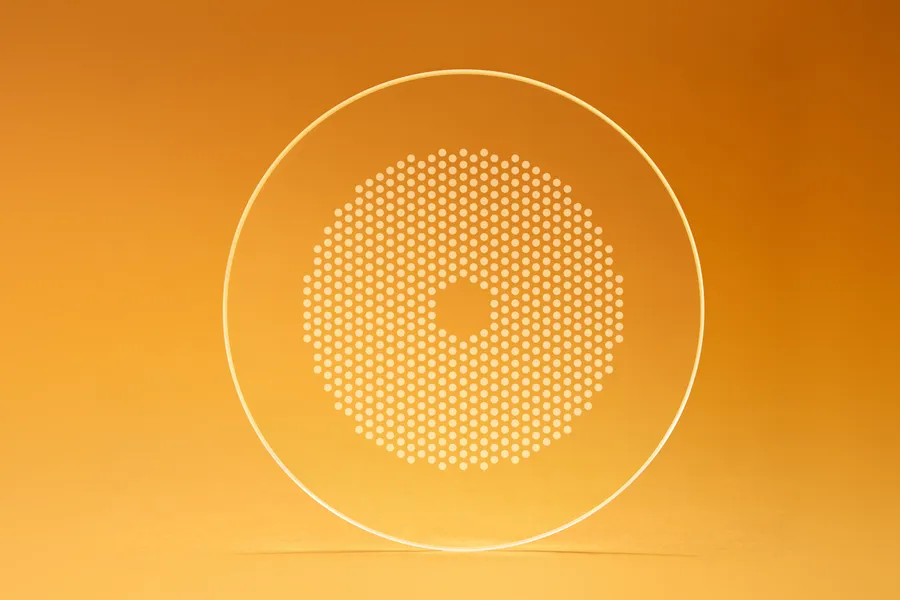
MiyoSmart iQ glasses · Ages 4+
HOYA's newest-generation DIMS lens, worn like any normal pair of glasses. Now available in Australia. The original MiyoSmart lens is still available too.
Prefer the original? Standard MiyoSmart is still available from $600.
Newest generation
Learn about MiyoSmart iQ
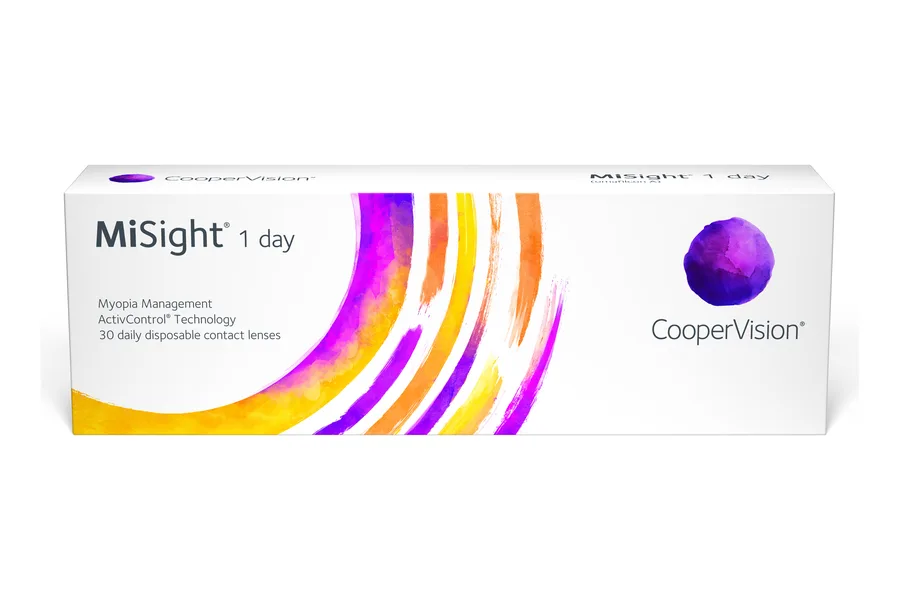
MiSight daily contacts · Ages 6+
Soft, single-use daily contact lenses. Good option for older children and teens who want an active-day solution.
Daily disposable
Learn about MiSight
Product images: HOYA (MiyoSmart) and CooperVision (MiSight). The ortho-K lens is our own 3D render.
Atropine eye drops
Low-dose atropine is a prescription-only eye drop. Some children use it on its own or alongside a lens. Whether it is worth considering for your child is something we talk through at the assessment.
Measure first. Then decide.
Why The Myopia Clinic
Four reasons parents choose us.
Advanced training in children's eyes
Children's eyes are a core part of what we do every week, and each of our optometrists has trained further in children's vision.
2,500+ children cared for by our optometrists
Across our careers, here and before. Based on our practice records.
Axial length optical biometry
At every follow-up, we measure your child's axial length with the ZEISS IOLMaster 500, an optical biometer also used by eye surgeons before surgery. You can see whether treatment is slowing their myopia and how the glasses prescription has changed.
Over 1,000 ortho-K lenses fitted between us
Between them, our optometrists have fitted over 1,000 ortho-K lenses, and Mark was one of the first optometrists in Australia to fit MiyoSmart, both the original and MiyoSmart iQ. Myopia care is a core part of our work, not a side service.
The team
Three optometrists, one focus on your child's eyes.
All three of us are therapeutically endorsed, and each of us brings extra paediatric and myopia-focused training.

Dr Mark Joung
Principal Optometrist
B.Optom (Hons), UNSW · Therapeutically endorsed · Advanced children's vision qualification (UNSW) · CIBA Vision Award, contact lens practice
Special interest in myopia control, dry eye and multifocal fitting.

Dr Nikki Peng
Optometrist
B.Optom (Hons), UNSW · Therapeutically endorsed · Advanced children's vision qualification (ACO) · Former clinician, Brien Holden Vision Institute
Special interest in contact lenses, myopia control, ortho-K and eye disease.
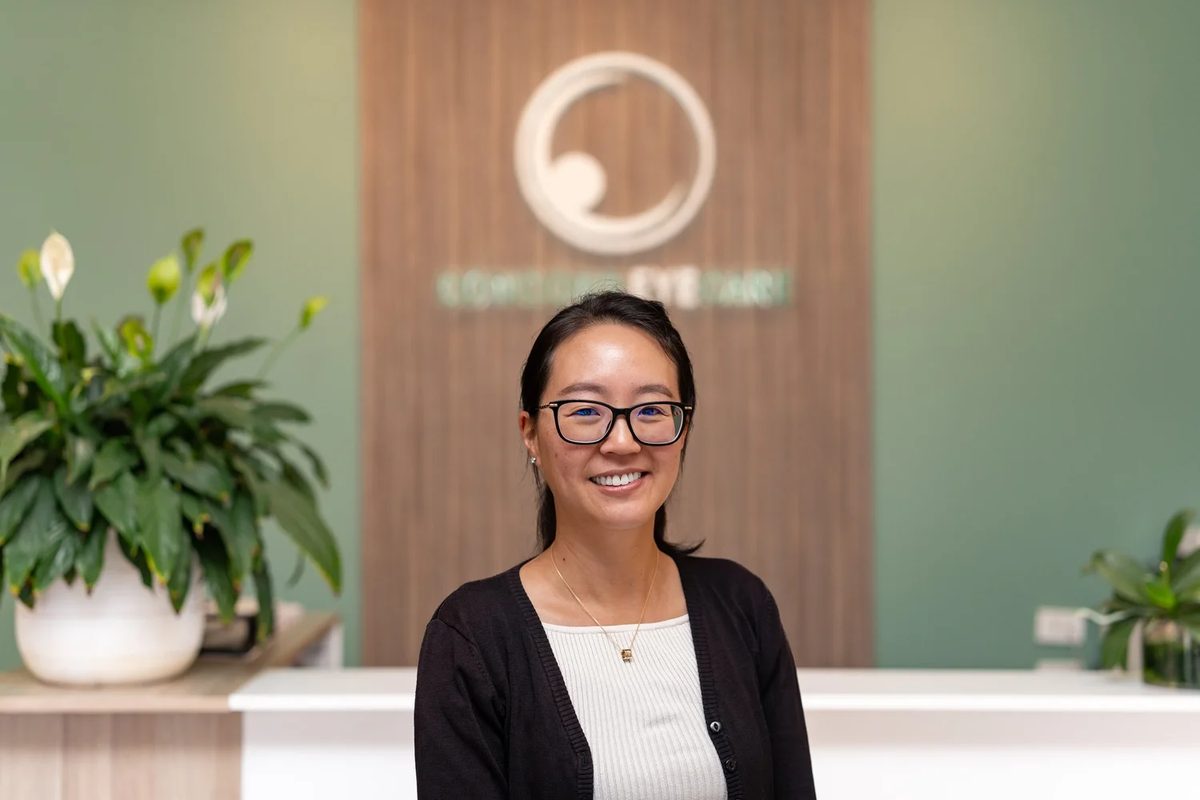
Dr Vivian Li
Optometrist
B.Optom (Hons), UNSW · Therapeutically endorsed · Advanced children's vision qualification (ACO) · ACBO Prize for children's vision
Special interest in children's vision, eye teaming and myopia.
The Myopia Clinic parent reviews
What families are saying.
★★★★★
"Mark was patient, kind, and professional, making her feel comfortable throughout the visit. We truly appreciate the clear explanations and the time taken to ensure she received the best care."
★★★★★
"I got my eyes tested by Mark and what he explained, no one else has explained to me this way — even though I've had eye tests in Australia for so many years. He genuinely cares about your eyes. I'm never going anywhere else."
★★★★★
"I take my two kids here. My experience is that they are always very professional, with a lot of care and patience. Especially for my son who has just been fitted with OrthoK lenses. The after care service has been exceptional."
Myopia control FAQs
What parents want to know about myopia control
How much does a myopia consultation cost?
The Children’s Myopia Assessment is $95 out of pocket — a dedicated one-hour appointment, with cycloplegic drops and axial-length measurement included. Treatment costs sit on top — see Ortho-K pricing for a full breakdown, or each treatment page for other options. Comparing spectacle lenses? See MiyoSmart vs Stellest vs MyoCare.
What ages do you treat?
We start axial length monitoring from around age 4–5. Active treatment can begin from about age 4 with MiyoSmart glasses, and from about age 6 with Ortho-K or MiSight. Most children start treatment between 6 and 10. Teens are absolutely welcome.
What happens at the first myopia consultation?
A full eye test, a cycloplegic refraction (dilated assessment so the prescription isn't masked by focusing), axial length measurement, and a conversation about which treatment options suit your child. Allow an hour. We also ask about screen time and outdoor habits. Both affect how quickly myopia gets worse.
How often will my child need follow-up appointments?
After starting treatment, we usually see your child every 6 months to measure axial length and prescription. If the eyes are getting worse fast or we're combining treatments, we may see them more often. All reviews are included in Ortho-K package pricing for the first 2 years. For a full picture of risks and how we manage them, see our Ortho-K safety guide.
How do you measure whether treatment is working?
We measure your child's axial length — the length of the eyeball itself — at every follow-up using the Zeiss IOLMaster 500 optical biometer. Axial length is the biological marker of myopia getting worse, and it's far more accurate than tracking prescription changes alone. Over time, you'll see a chart of exactly how your child's eyes are tracking.
How much do myopia control glasses and lenses cost?
Myopia control glasses are $690 a pair for Stellest 2.0 or ZEISS MyoActive, and $750 for MiyoSmart iQ with its Spark coating included. Ortho-K is from $1,600 for the first two years, including every fitting visit. We explain every fee at the assessment, before you decide.
Is myopia control worth it?
For a child whose eyes are getting worse, the evidence supports it: ortho-K, MiyoSmart and MiSight each slowed axial length progression compared with ordinary glasses or contact lenses in their own trials (Cho and Cheung, 2012; Lam et al., 2020; Chamberlain et al., 2019). The researchers' point is that each dioptre matters (Bullimore and Brennan, 2019).
What happens when we stop treatment?
Once your child is 18 or older, stopping becomes an option. If eye length is still growing, the eyes are still getting worse and further myopia control may be needed. Stopping earlier leaves the eyes to grow at their untreated pace again, so we keep measuring until axial length progression has settled.

Clinically reviewed by Dr Mark Joung, B.Optom (Hons) UNSW, Certificate in Ocular Therapeutics (ACO), Advanced Paediatric Eye Care UNSW
Last clinically reviewed: April 2026.
For independent information on childhood myopia, visit Myopia Focus
The 2,500+ and 1,000+ figures come from our optometrists' practice records across their careers (October 2026).
References (12)
- Holden BA, Fricke TR, Wilson DA, et al. Global Prevalence of Myopia and High Myopia and Temporal Trends from 2000 through 2050. Ophthalmology. 2016;123(5):1036-1042.
- Bullimore MA, Brennan NA. Myopia Control: Why Each Diopter Matters. Optom Vis Sci. 2019;96(6):463-465.
- Brennan NA, Toubouti YM, Cheng X, Bullimore MA. Efficacy in myopia control. Prog Retin Eye Res. 2021;83:100923.
- Cho P, Cheung SW. Retardation of Myopia in Orthokeratology (ROMIO) Study: a 2-year randomized clinical trial. Invest Ophthalmol Vis Sci. 2012;53(11):7077-7085.
- Lam CSY, Tang WC, Tse DY-Y, et al. Defocus Incorporated Multiple Segments (DIMS) spectacle lenses slow myopia progression: a 2-year randomised clinical trial. Br J Ophthalmol. 2020;104(3):363-368.
- Chamberlain P, Peixoto-de-Matos SC, Logan NS, et al. A 3-year randomized clinical trial of MiSight lenses for myopia control. Optom Vis Sci. 2019;96(8):556-567.
- Yam JC, Li FF, Zhang X, et al. Two-Year Clinical Trial of the Low-Concentration Atropine for Myopia Progression (LAMP) Study. Ophthalmology. 2020;127(7):910-919.
- Tideman JWL, Polling JR, Vingerling JR, et al. Axial length growth and the risk of developing myopia in European children. Acta Ophthalmologica. 2018;96(3):301-309.
- Gifford KL, Richdale K, Kang P, et al. IMI – Clinical Management Guidelines Report. Invest Ophthalmol Vis Sci. 2019;60(3):M184-M203.
- McCullough S, Adamson G, Breslin KMM, McClelland JF, Doyle L, Saunders KJ. Axial growth and refractive change in white European children and young adults: predictive factors for myopia. Sci Rep. 2020;10:15189.
- Wolffsohn JS, Flitcroft DI, Gifford KL, et al. IMI – Myopia Control Reports Overview and Introduction. Invest Ophthalmol Vis Sci. 2019;60(3):M1-M19.
- COMET Group. Myopia stabilization and associated factors among participants in the Correction of Myopia Evaluation Trial (COMET). Invest Ophthalmol Vis Sci. 2013;54(13):7871-7884.