DRY EYE CLINIC · SYDNEY
Dry eye treatment Sydney
Most "dry eye" isn't dryness. About 86% of cases are evaporation from blocked oil glands. Drops don't fix it. We diagnose the type first, then treat the cause.
- ★ 4.9 from 200+ Google reviews
- Additional qualifications All of our optometrists hold additional qualifications to deliver a high standard of care
- All health funds HICAPS on the spot
SYMPTOMS
Do these chronic symptoms sound familiar?
Common signs of dry eye disease
Dry eye symptoms aren't always "dryness." Burning, watering, intermittent blur, light sensitivity, scratchy or gritty sensations, tired eyes after screen work, and crusty lashes on waking are all classic presentations. If you're using drops daily and not getting lasting relief, the underlying cause hasn't been addressed.
The assessment below uses the international TFOS DEWS II diagnostic criteria. Tick the symptoms you experience regularly to get an indicative symptom burden score. It's useful context to bring to your $50 Dry Eye Assessment Package.
This is an educational symptom check, not a diagnosis. This gives you a sense of your symptom burden. Only a clinical assessment can identify what's causing your symptoms and what will help.
Dry Eye Symptom Check
Informed by the symptom areas used in the TFOS DEWS II framework. Tick the symptoms you notice regularly to see your symptom burden.
Answer all six first.
Symptom burden
These are the kinds of symptoms worth getting assessed properly. We can work out what's behind them and talk through the options that fit.
If you're ticking several of these, it's worth getting a proper assessment. Dry eye is a chronic condition. It doesn't go away on its own, and it tends to get worse if the underlying cause isn't treated.
WHAT IS DRY EYE
Why are there three types of dry eye?
Most "dry eye" isn't dry
Dry eye disease is classified into three subtypes by the international TFOS DEWS II Report (Craig et al., 2017): evaporative, aqueous-deficient, and mixed. Approximately 86% of dry eye is evaporative. It's caused by meibomian gland dysfunction (MGD), not a lack of tear volume. The treatment pathway is different for each.
Most people reach for over-the-counter drops, assuming "dry eye" means their eyes don't make enough tears. For the majority of patients, that's the wrong answer. Their eyes are making tears. The oil layer that should be slowing evaporation has broken down, and the tears are evaporating before they can do their job. Drops alone don't repair the oil glands.
| Feature | Evaporative dry eye | Aqueous-deficient | Mixed dry eye |
|---|---|---|---|
| Mechanism | Tear film evaporates too fast due to oil-layer deficiency | Lacrimal glands produce insufficient tear fluid | Both mechanisms together |
| Prevalence | ~86% of cases (Lemp 2012) | ~10% of cases | Common in long-standing disease |
| Common causes | Meibomian gland dysfunction, blepharitis, demodex, ageing | Sjögren's syndrome, autoimmune disease, some medications | Often what untreated evaporative disease becomes |
| Key diagnostic test | Meibography + NIBUT | Schirmer's test + osmolarity | Full diagnostic panel |
| First-line treatment | Lid hygiene, warm compresses, IPL therapy | Tear supplementation, punctal plugs | Combination — lid-focused + tear supplementation |
HOW WE DIAGNOSE
How do you diagnose the type of dry eye?
Finding out why your eyes are dry
A dry eye assessment at Concord Eyecare combines a detailed history with non-invasive diagnostic imaging: non-invasive tear break-up time (NIBUT), meibography, lid examination, Schirmer's test where indicated, and tear film analysis (Wolffsohn et al., 2017). The goal is to identify which subtype of dry eye you have before recommending any treatment.
Standard eye tests don't usually look closely at the tear film or the oil glands. A proper dry eye work-up needs different equipment and a different conversation (symptom patterns, screen use, medications, contact lens history, hormonal changes), backed up by diagnostic imaging.
EQUIPMENT · MEDMONT E300
Non-invasive tear break-up time (NIBUT)
The Medmont E300 projects a pattern onto your tear film and measures how long it stays stable. No fluorescein dye, no stopwatch. Tells us whether your tear film is breaking down too fast. That's the hallmark of evaporative dry eye.
IMAGING · MEIBOVUE MEIBOGRAPHER
Meibography
The Meibovue meibographer images the oil glands in your eyelids. Healthy glands are long and intact. Damaged or atrophied glands look shortened or absent. This is structural information. It tells us how much gland function we're working with.
DIAGNOSTIC · AQUEOUS DEFICIENCY
Schirmer's test (when indicated)
For suspected aqueous-deficient dry eye, the Schirmer's test measures actual tear production volume over five minutes. Used selectively. Not every patient needs it, but it's the standard test for tear volume.
CLINICAL EXAM · SLIT LAMP
Tear film and lid assessment
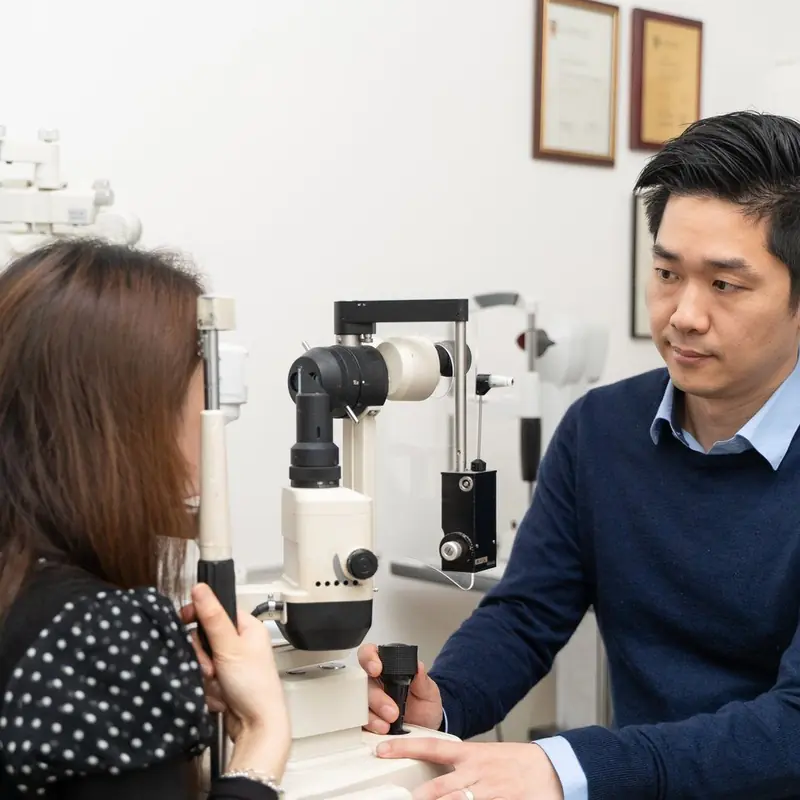
Slit-lamp examination of the lid margins, lash base, and meibomian gland openings. Helps us identify blepharitis, demodex, and gland blockages that drive evaporative dry eye.
If you'd like the diagnostic work-up without committing to a full treatment programme, our $50 Dry Eye Assessment Package is the place to start. It's useful if you want to know what's going on before deciding on next steps.
Dry Eye Assessment Package
Includes
- Tear break-up test (NIBUT)
- Oil-gland imaging (meibography)
- Schirmer tear test, if needed
Time
At least 20 minutes
Fee
$50
IPL TREATMENT
Treating the root cause of dry eye
Medical-grade IPL for evaporative dry eye
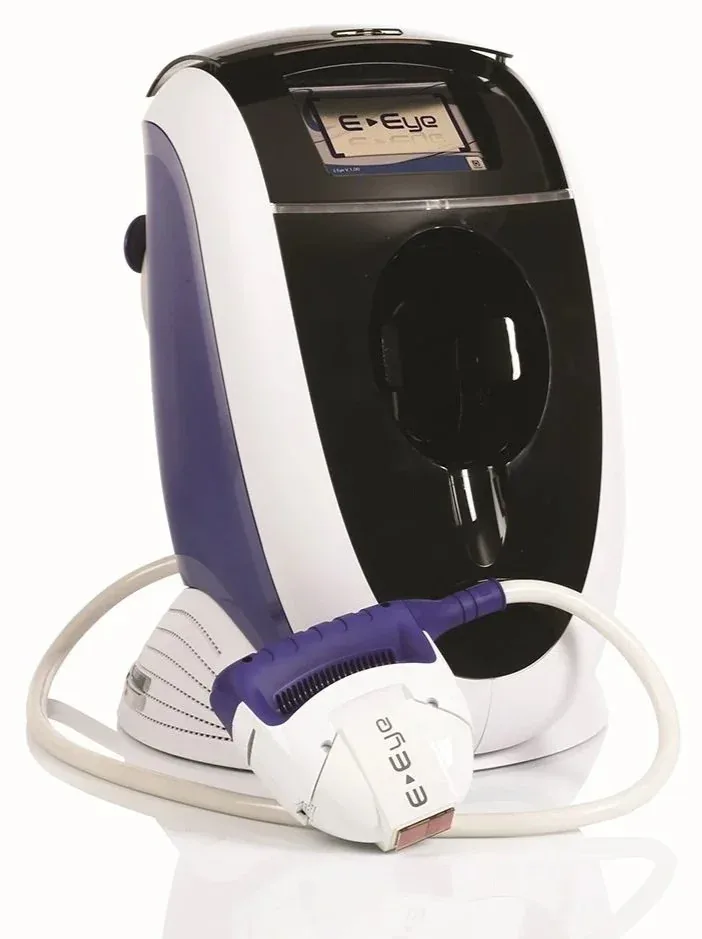
For moderate to severe meibomian gland dysfunction and evaporative dry eye, IPL (Intense Pulsed Light) targets the underlying inflammation. We use the E-Eye device, a medical-grade IPL system designed specifically for dry eye. The $850 pathway covers the Dry Eye Assessment Package and four sessions over three months.
From $850
Assessment and four sessions
Costs
What does dry eye care cost?
We set out every fee before any treatment starts.
Dry Eye Assessment Package
$50
on top of the consultation
NIBUT, meibography and a Schirmer test if needed, at least 20 minutes
Shows what is behind the dryness. Part of the $850 if you go on to IPL.
IPL Treatment Pathway
$850
assessment and four sessions
Four IPL sessions over three months
Or $800 for the four sessions when you go straight to IPL.
IPL top-up session
$200
per session
One extra IPL session
Booked when a review shows your glands need it, not as a set course.
- Eye examination
- Currently bulk billed for eligible Medicare card holders
- Medicare
- IPL and the dry eye tests are not covered
- Health funds
- HICAPS on the spot; cover for dry eye care varies by fund
Ready to find out what's going on?
WHY CONCORD EYECARE
Dry eye is a spectrum. We treat it as one.



Diagnosis-first, treatment second. Always
Dr Nikki Peng has been writing about dry eye since 2009 (mivision, "Redefining Dry Eye"). All three optometrists are therapeutically endorsed. We invested in dedicated dry eye diagnostic equipment (Meibovue meibography and Medmont E300 NIBUT) because we treat dry eye as the chronic inflammatory disease it is, not as a drops conversation.
DIAGNOSIS
We work out the type first
Evaporative, aqueous-deficient, or mixed — the right treatment depends on which one you have. A proper diagnosis is why IPL works for the right patients, and why we don't recommend it for the wrong ones.
SPECIALISED DRY EYE TESTING
Equipment for finding the cause
Meibography and non-invasive tear break-up time aren't part of a standard eye test. They're dedicated dry eye diagnostics that need dedicated equipment. We have both: the Meibovue meibographer and the Medmont E300.
FULL SCOPE OF CARE
Everything under one roof
All three optometrists are therapeutically endorsed. If you need prescription drops or medication alongside lid therapy or IPL, we prescribe directly and keep it all in one clinical file.
PATIENT REVIEW
What a dry eye patient said
Real experience from a Sydney patient
★★★★★
"Mark treated my dry eyes with IPL and I can't thank him enough. I've been suffering with dryness for the past few years and my eyes use to look red, sore and tired no matter how many times I put lubricating drops in. After my 3rd session of IPL, I noticed an improvement and by the 4th session, the dryness was almost completely gone. I'm so happy! Now I can sit in front of the computer and be in an air conditioning room without feeling any irritation or blinking every second. An added bonus is my right eye (the eye that suffered with more dryness) use to be more droopy than my left eye but since the treatment, they're symmetrical, yay! Not sure if it was a coincidence but either way I'm really happy with the results and service. Thanks again Mark!"
Amy S. · Verified Google Review · 2024
COMMON QUESTIONS
Dry eye: your questions answered
Six questions we hear from patients every week
What causes dry eye?
Most dry eye is caused by meibomian gland dysfunction — the oil glands in your eyelids stop producing enough quality oil, and your tear film evaporates too quickly. The international TFOS DEWS II Report (2017) puts evaporative disease at roughly 86% of cases. Other causes: age-related tear gland decline, autoimmune conditions like Sjögren's syndrome, prolonged screen use, contact lens overwear, and certain medications. The first step is identifying which mechanism applies to you.
Can dry eye be cured?
Dry eye is generally a chronic condition rather than something that's cured outright. But it can be well controlled. With the right diagnosis and a treatment plan that addresses the underlying cause, most patients experience meaningful, lasting improvement. The goal is symptom control and protection of the meibomian glands you still have.
How do you diagnose dry eye?
A proper diagnosis combines a detailed history with diagnostic imaging — non-invasive tear break-up time (NIBUT), meibography, slit-lamp examination of the lids and tear film, and Schirmer's test where aqueous deficiency is suspected. These tests aren't part of a standard eye test and need dedicated equipment. They tell us which subtype of dry eye you have so we can recommend the right treatment.
Is dry eye treatment covered by Medicare?
The diagnostic consultation is generally covered by Medicare when bulk-billed. Some treatments are not Medicare-eligible, including IPL and dedicated dry eye assessments using specialised equipment. We're upfront about which parts of your treatment are bulk-billed and which carry a fee, before you commit to anything.
What's the difference between evaporative and aqueous-deficient dry eye?
Evaporative dry eye (about 86% of cases) happens when the oil layer of your tears breaks down and tears evaporate too quickly — usually from meibomian gland dysfunction. Aqueous-deficient dry eye (about 10%) happens when the lacrimal glands don't produce enough fluid — often related to autoimmune disease like Sjögren's syndrome. The treatment pathway is different for each. Diagnosis decides direction.
What is the best treatment for dry eye?
The one that matches the cause, so we test first. For blocked oil glands we work in steps: warm compresses and lid care, prescription anti-inflammatory drops when needed, then IPL when the glands stay blocked. Lubricating drops ease symptoms at every step (TFOS DEWS II Management and Therapy Report, 2017).
Related conditions
Dig deeper into dry eye
Conditions and treatments explained
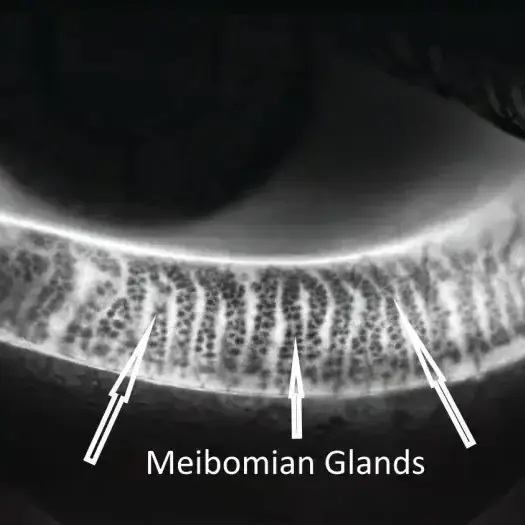
Meibomian gland dysfunction
The mechanism behind ~86% of dry eye, and how we diagnose it with meibography.
Blepharitis treatment
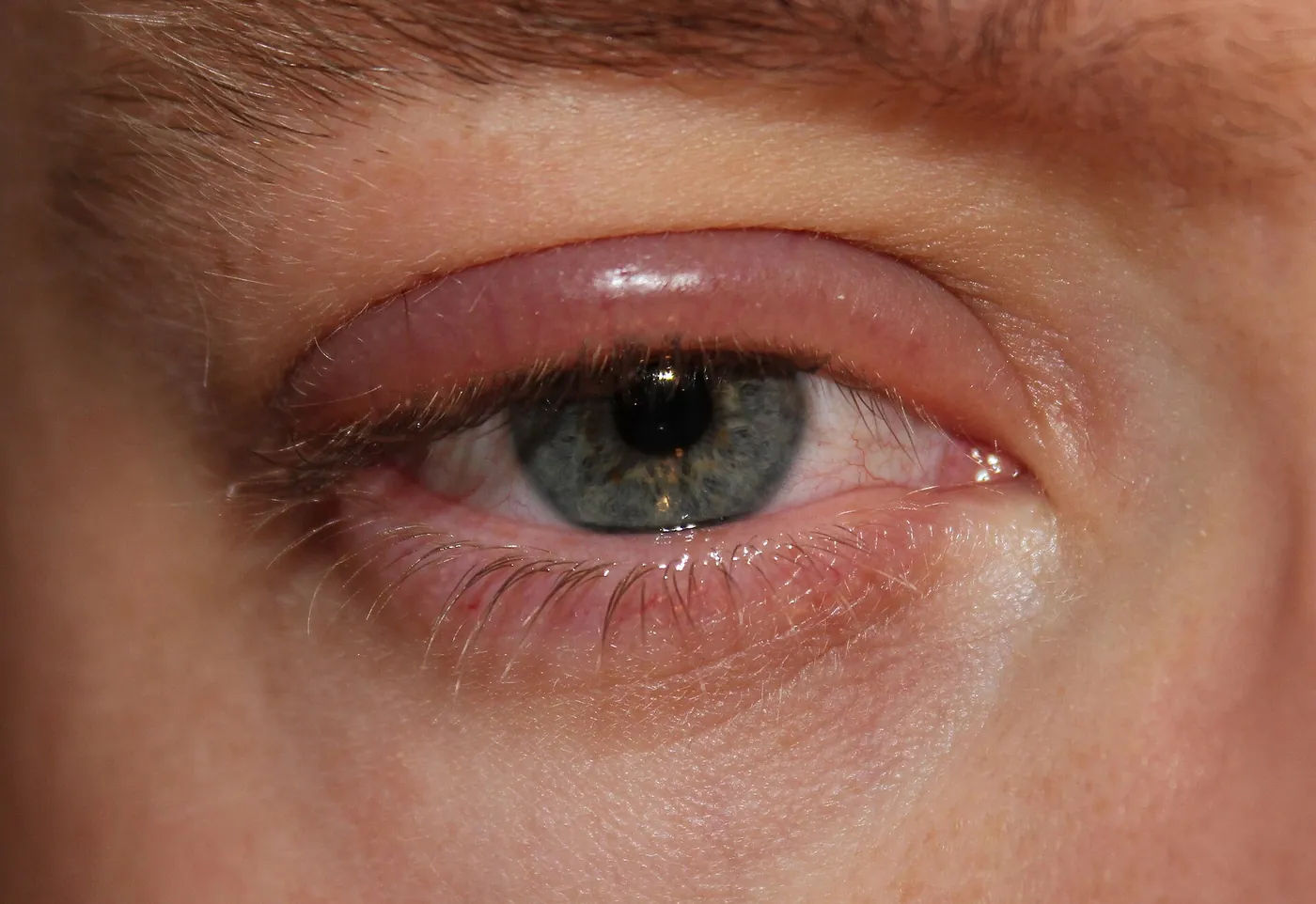
Chronic eyelid inflammation driven by bacteria or demodex mites.
Demodex blepharitis
Demodex mites on the lash base cause cylindrical dandruff and persistent irritation.
Omega-3 for dry eyes
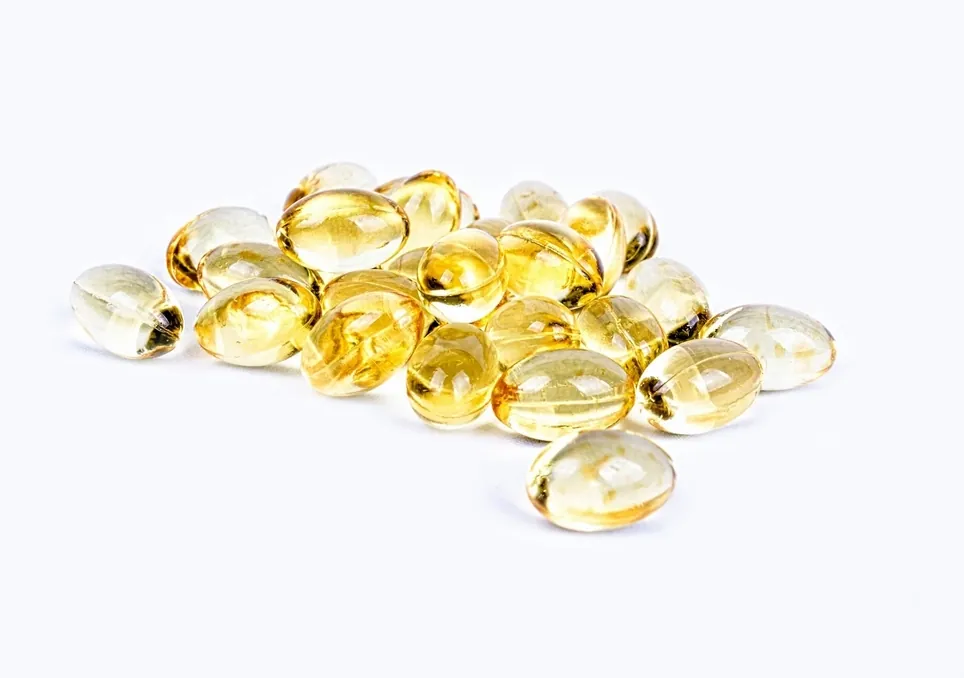
The right omega-3 can support your tear film. Dose, form and quality matter.

Reviewed by Dr Nikki Peng · Last updated May 2026
References (7)
- Craig JP, Nichols KK, Akpek EK, et al. (2017). TFOS DEWS II Definition and Classification Report. The Ocular Surface, 15(3):276–283.
- Wolffsohn JS, Arita R, Chalmers R, et al. (2017). TFOS DEWS II Diagnostic Methodology Report. The Ocular Surface, 15(3):539–574.
- Jones L, Downie LE, Korb D, et al. (2017). TFOS DEWS II Management and Therapy Report. The Ocular Surface, 15(3):575–628.
- Stapleton F, Alves M, Bunya VY, et al. (2017). TFOS DEWS II Epidemiology Report. The Ocular Surface, 15(3):334–365.
- Lemp MA, Crews LA, Bron AJ, Foulks GN, Sullivan BD. (2012). Distribution of aqueous-deficient and evaporative dry eye in a clinic-based patient cohort. Cornea, 31(5):472–478.
- Nichols KK, Foulks GN, Bron AJ, et al. (2011). The International Workshop on Meibomian Gland Dysfunction: Executive Summary. Investigative Ophthalmology & Visual Science, 52(4):1922–1929.
- Toyos R, McGill W, Briscoe D. (2015). Intense pulsed light treatment for dry eye disease due to meibomian gland dysfunction. Photomedicine and Laser Surgery, 33(1):41–46.
Serving Sydney families and individuals with chronic dry eye. Concord Eyecare is located at 161 Concord Road, North Strathfield. Patients travel from across the Inner West and Greater Sydney (including Concord, Drummoyne, Abbotsford, Burwood, Five Dock, Strathfield, Homebush, Rhodes, Mosman, Lane Cove, and the Hills district) for dedicated dry eye assessment and IPL therapy.
Your eyes don't have to feel like this forever
All three optometrists are therapeutically endorsed. Bookings Monday to Saturday.