Myopia control · Sydney
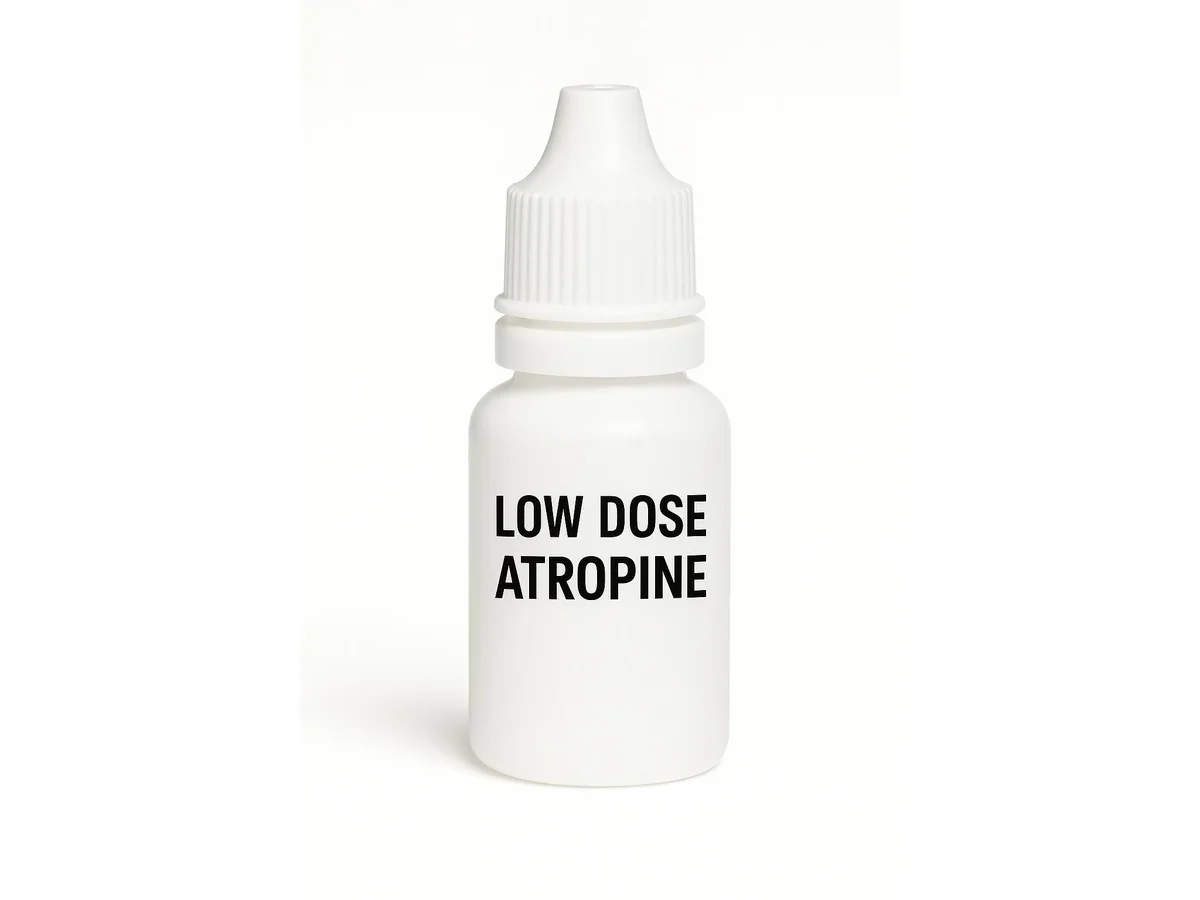
Atropine eye drops for myopia control
One bedtime drop slows childhood myopia.
We usually add it to lens-based treatment.
- ★ 4.9 from 200+ Google reviews
- Advanced qualifications in children's vision All of our optometrists hold advanced qualifications in children's vision
- 2,500+ children cared for by our optometrists
- 1,000+ ortho-K lenses fitted between our optometrists
About atropine
What is low-dose atropine?
A prescription drop we use 20 to 100 times weaker than the drops that widen pupils for eye exams.
100+ yrs
In eye care
High strengths for examinations; very low strengths to slow childhood myopia.
1 drop
Each eye, at bedtime
Your child has no lens to wear or daytime routine.
2 trials
ATOM and LAMP
Singapore and Hong Kong studies show what works and the side effects at each strength.
How it works
How does atropine slow myopia?
It signals the eye to slow its growth. It does not correct vision.
Where it acts
Likely on receptors in the sclera (the eye's white outer layer) and retina that influence axial length progression. The mechanism is still under investigation.
How we check it
Axial length (eye length in millimetres) alongside the prescription, which can stabilise for unrelated reasons.
Strength and side effects
At 0.01% to 0.05%, pupil widening and near blur are reduced. Higher strengths slow myopia more, with more side effects.
Your options
How does atropine compare?
No single myopia treatment is best; the right choice depends on your child.
Ortho-K
Overnight contact lenses. Suits active kids, swimmers, glasses-free days.
MiSight
Daily disposable contact lenses, worn in the day. Suits children who want freedom from glasses, sport.
MiyoSmart glasses
Daytime glasses. Suits younger children; the simplest option.
Low-dose atropine
One drop at bedtime. An add-on, or when lenses and glasses are not suitable.
For most children we see, we start with a lens-based treatment (Ortho-K, MiSight contact lenses or MiyoSmart glasses). We add atropine only if the eyes are still getting worse too quickly at the 6-month review.
Strength
Which strength works best?
Stronger drops slowed eye changes more in the LAMP study (Yam et al., 2019).
27%
0.01%
Slower prescription change than placebo drops in LAMP's first year; the smallest effect of the three strengths.
43%
0.025%
Slower prescription change than placebo drops in LAMP's first year; more effect than 0.01% with fewer side effects than 0.05%.
67%
0.05%
Slower prescription change than placebo drops in LAMP's first year; the strongest effect and the most noticeable side effects.
Source: LAMP study, Yam et al. 2019, Ophthalmology. First-year results; each strength compared with placebo drops.
These are trial averages; some children respond more, some less. Axial length at 6-monthly reviews shows how your child responds.
Suitability
Is atropine right for my child?
Atropine fits well when
- Your child isn't ready or suited for contact lenses
- Specialty glasses (MiyoSmart/Stellest) aren't working or tolerated
- If axial length progression is faster than normal for age (about 0.1 to 0.2 mm a year in primary school, about 0.1 mm after 10), we talk with you about adding or changing treatment, after checking how your child's eyes focus together.
- Family is comfortable with a daily medication routine
A lens-based option may fit better when
- Your child handles lenses or glasses well
- You'd prefer a non-medication approach first
- Light sensitivity or near-blur would be a meaningful problem
- The change is early and moderate: a lens option is usually our default
These are patterns we see, not rules.
Side effects
What are the side effects?
Atropine widens the pupil a little and relaxes focusing slightly; here is what that looks like day to day.
Light sensitivity
The most common effect; stronger at 0.05% than 0.01%. Most children adapt within weeks. Photochromic lenses or sunglasses help.
Near blur
Close work may look slightly fuzzy at higher strengths, mostly in the first weeks. Homework occasionally needs reading glasses.
Larger pupils
Pupils look slightly larger, especially indoors. This is cosmetic and harmless.
Brief stinging
Common in the first week or two; settles within seconds of the drop going in.
Headaches, dry mouth and heart-rate changes are not expected at these low strengths; allergic reactions are rare. The main effects reverse within days of stopping and cause no permanent visual change. If they trouble your child, we lower the strength, plan a break or switch treatment.
Stopping treatment
When can my child stop atropine?
Usually once axial length progression settles, and always with a gradual taper.
Taper, never stop suddenly
A sudden stop can bring a rebound, more at higher strengths (Yam et al., 2022).
Decided by eye length
We use six-monthly eye length measurements, not age alone.
Keep a spare supply
So the drops never run out between scripts.
Atropine sulfate strengths
What are 0.01%, 0.025% and 0.05% atropine used for?
All three are atropine sulfate eye drops. The strength depends on the job.
0.01%
With a lens
Usually added to ortho-K, MiSight or myopia control glasses.
0.025%
On its own
For mild to moderate change when lenses don't suit.
0.05%
Stronger
On its own for faster change. The largest LAMP effect, with more light sensitivity.
Eikance is TGA-registered in all three strengths. Compounded atropine is the alternative when it does not suit.
Not sure which treatment is right for your child?
Alone or combined
Atropine alone, or with a lens?
Monotherapy
Atropine on its own
An evidence-based approach. Over two years of the LAMP study, 0.05% on its own slowed myopia the most of the three strengths tested (Yam et al., 2020). It suits families where contacts or specialty glasses aren't workable, or where simplicity is a priority.
The trade-off: one treatment mechanism. If your child responds less strongly to atropine, we have fewer options if the eyes keep getting worse.
Our typical approach
Atropine plus a lens
We add atropine to MiyoSmart glasses, MiSight contact lenses or Ortho-K. The two work through different mechanisms, so combining them can produce better myopia control than either alone, particularly when the eyes are getting worse quickly.
When this comes in: often at the 6-month review, if axial length still grows faster than we'd like. For ortho-K, the drop goes in at bedtime a few minutes before the lenses.
Our approach
How we use atropine at Concord Eyecare

Dr Mark Joung
Optometrist & Practice Director
B.Optom (Hons), UNSW. Therapeutically endorsed, with an advanced children's vision qualification (UNSW) and the CIBA Vision Award for contact lens practice. Special interest in myopia control, dry eye and multifocal fitting.

Dr Nikki Peng
Optometrist
B.Optom (Hons), UNSW. Therapeutically endorsed, with an advanced children's vision qualification (ACO) and past clinical work at the Brien Holden Vision Institute. Special interest in contact lenses, myopia control, ortho-K and eye disease.

Dr Vivian Li
Optometrist
B.Optom (Hons), UNSW. Therapeutically endorsed, with an advanced children's vision qualification (ACO) and the ACBO Prize for children's vision. Special interest in children's vision, eye teaming and myopia.
"For most of our myopia patients, we start with a lens-based treatment (MiyoSmart or Stellest glasses for younger or contact-averse children, MiSight or Ortho-K for older or active children) and add atropine if the eyes are still getting worse faster than we'd like at the 6-month review."
Why lenses first, in our dedicated myopia control clinic: the 0.05% strength has side effects that lead some families to stop, a child wearing glasses is visibly wearing the treatment while a bedtime drop is harder to confirm, and starting with a lens keeps atropine available as a second step.
For children who can't tolerate lenses, we prescribe atropine on its own without hesitation, usually at 0.025% or 0.05% based on the LAMP evidence.
What to expect
Visits and costs
An assessment, then reviews every six months.
Visit 1
Assessment
Cycloplegic refraction, eye health and baseline axial length.
Every night
The routine
One drop in each eye at bedtime. No lens to manage or special glasses.
Every 6 months
Reviews
Axial length, refraction and side effects checked; then continue, adjust or change.
After visit 1
The prescription
We choose the strength and write it; a pharmacy supplies the drops.
Cost. Most of your child's eye exam is currently bulk-billed for eligible Medicare card holders. SightTrack monitoring is $120 a year, billed privately: eye-length checks every 6 months, a progress review and the SightTrack report. Drops cost about $50 a month, paid to the pharmacy.
Atropine FAQ
Atropine questions
How effective is atropine for myopia?
It depends on the strength. In the first year of the LAMP study, prescription change was 67% slower than with placebo drops at 0.05%, 43% at 0.025% and 27% at 0.01% (Yam et al., 2019). Research suggests adding atropine to some lens treatments, such as ortho-K, can add to the effect.
What are the main side effects?
Light sensitivity and mild near-blur, more noticeable at 0.05% than 0.01%. Pupils look slightly larger than normal. Brief stinging when the drop goes in, usually settles within seconds. Most children adapt within a few weeks. All effects reverse when treatment stops.
Which concentration do you prescribe?
It depends on how fast the myopia is changing. Alongside ortho-K or myopia control glasses, usually 0.01%. On its own, usually 0.025% or 0.05%, based on the LAMP evidence. We lower the strength if side effects are a problem.
Is atropine for myopia TGA-approved in Australia?
Yes. Eikance is TGA-registered at 0.01%, 0.025% and 0.05% and available from community pharmacies. Compounded atropine is used when Eikance does not suit a child.
Can atropine be combined with MiSight, MiyoSmart, or Ortho-K?
Yes. This is often how we use atropine, particularly when the eyes are still getting worse faster than we'd like on a lens-based treatment alone. The two approaches work through different mechanisms, so the combination can be stronger than either alone.
Is atropine covered by Medicare or private health?
No. Atropine for myopia control isn't on the PBS, and private health funds don't cover it. The drops are paid directly to the pharmacy. SightTrack monitoring for children whose treatment is prescribed eye drops is $120 a year: eye-length checks every 6 months, a progress review and the SightTrack report.
How do I know if it's working?
Axial length measurement on our Zeiss IOLMaster 500 at every 6-monthly review. Prescription changes alone can be misleading; axial length is the objective marker that tells us whether the drops are slowing axial length progression as intended.
What if my child has bad side effects?
We adjust: lower the concentration, take a planned break, or switch to a different myopia control treatment. Your child's quality of life matters more than staying on a particular treatment.

Reviewed by Dr Mark Joung B.Optom (Hons) UNSW · Certificate in Ocular Therapeutics (ACO) · Last updated April 2026
The 2,500+ and 1,000+ figures come from our optometrists' practice records across their careers (October 2026).
References (8)
- Yam JC, Jiang Y, Tang SM, et al. Low-Concentration Atropine for Myopia Progression (LAMP) Study: A Randomized, Double-Blinded, Placebo-Controlled Trial of 0.05%, 0.025%, and 0.01% Atropine Eye Drops in Myopia Control. Ophthalmology. 2019;126(1):113-124.
- Yam JC, Li FF, Zhang X, et al. Two-Year Clinical Trial of the Low-Concentration Atropine for Myopia Progression (LAMP) Study: Phase 2 Report. Ophthalmology. 2020;127(7):910-919.
- Yam JC, Zhang XJ, Zhang Y, et al. Three-Year Clinical Trial of Low-Concentration Atropine for Myopia Progression (LAMP) Study: Continued Versus Washout. Ophthalmology. 2022;129(3):308-321.
- Chia A, Lu QS, Tan D. Five-Year Clinical Trial on Atropine for the Treatment of Myopia 2: Myopia Control with Atropine 0.01% Eyedrops. Ophthalmology. 2016;123(2):391-399.
- Optometry Australia. Position Statement on Myopia Management. December 2024.
- Aspen Pharmacare Australia. EIKANCE Product Information (0.01%, 0.025%, 0.05%). TGA ARTG; 0.025% entry 408371.
- Flitcroft DI, He M, Jonas JB, et al. IMI: Defining and classifying myopia: A proposed set of standards. Invest Ophthalmol Vis Sci. 2019;60(3):M20-M30.
- Repka MX, Weise KK, Chandler DL, et al. Low-Dose 0.01% Atropine Eye Drops vs Placebo for Myopia Control: A Randomized Clinical Trial. JAMA Ophthalmol. 2023;141(8):756-765. (CHAMP trial)