
MYOPIA · THE MYOPIA CLINIC AT CONCORD EYECARE
What Is Myopia?
Myopia (short-sightedness) is when distant objects look blurry while close-up vision stays clear.
Raine Study: 691 young adults, measured at 20 and again at 28
37.8%
of young adults in a Perth study had their eyes shift towards short‑sightedness between 20 and 28.
A shift of 0.5 dioptres or more in at least one eye. For most, the change was small.
Lee et al. 2022, JAMA Ophthalmology
- ★ 4.9 from 200+ Google reviews
- Advanced qualifications in children's vision All of our optometrists hold advanced qualifications in children's vision
- 2,500+ children cared for by our optometrists
- 1,000+ ortho-K lenses fitted between our optometrists
Myopia Basics
A longer eyeball.
It happens because the eyeball grows a little too long, so light focuses just in front of the retina instead of on it. In children it usually keeps getting worse. It typically starts in primary school and increases year by year without intervention. The good news: evidence-based treatments can slow it down significantly.
Your child's been told they're short-sighted — now what? Here's what myopia is, why it matters, and what you can do about it.
Myopia is short-sightedness. It happens when the eye grows slightly too long from front to back, so light focuses just in front of the retina instead of on it. Close objects stay clear. Distant ones look blurry. That extra length is the part that matters. It tends to keep increasing, and it's what we can slow down.
Here's the simple analogy we use across the consultation desk: imagine a camera where the lens is stuck at a fixed point but the body keeps stretching backwards. The image lands in front of where it should. Glasses compensate by bending the light. They don't shorten the eye.
This is why two children with the same prescription can have very different long-term outlooks. The one whose eye is still elongating needs active management. The one whose eye has stabilised just needs good glasses.
MYOPIA VS “JUST NEEDING GLASSES”
Getting worse is the real problem.
Glasses correct vision. They don't stop myopia from getting worse. Without treatment, a short-sighted child's prescription typically changes by around -0.50 to -1.00 dioptres per year through primary school. That means new glasses every 6 to 12 months, and a higher final prescription that carries real eye-health risk in adulthood.
If your child's prescription jumps from -1.00 to -2.00 between Year 3 and Year 5, standard glasses kept vision clear but didn't slow anything down. That matters because the final level of myopia a child reaches is what determines their lifetime risk of serious eye disease — not whether they can see the whiteboard today.
This is the shift most parents don't hear about at a standard eye test. Myopia control is a different kind of treatment. It's designed to slow the eye's elongation itself. We explain the main options further down this page.
MYOPIA LONG-TERM HEALTH RISKS
It's about sight, and eye health at 50.
Higher levels of myopia significantly increase the lifetime risk of several serious eye conditions. This is the strongest argument for starting myopia control early. The goal is to keep the final prescription as low as possible.
50%of the world's population projected to be myopic by 2050 (Holden et al., 2016)
67%increased risk of ocular disease for every 1 dioptre of myopia (Bullimore, 2019)
31%of Sydney 17-year-olds are now myopic — roughly double a generation ago (French et al., 2013)
Up to 22× risk at high myopia
Myopic maculopathy
Damage to the central retina from eye-length stretching. The leading cause of permanent vision loss in high myopes and largely untreatable once established.
Up to 21× risk at high myopia
Retinal detachment
The stretched retina can tear or separate. It is an emergency when it happens, and dramatically more likely as myopia increases.
Up to 3× risk
Glaucoma
A progressive optic nerve disease. Myopic eyes are more susceptible, and glaucoma often develops silently until significant vision loss has occurred.
Up to 3× risk
Cataract (earlier onset)
Myopic eyes tend to develop clouding of the natural lens earlier and more aggressively than non-myopic eyes.
MYOPIA RISK FACTORS IN CHILDREN
It's part genes, part lifestyle.
Myopia doesn't have a single cause. It's the interaction of what your child was born with and how their eyes are used every day. Some factors you can't change. But some you can.
What you can't change
Family history
One myopic parent roughly triples the risk. Two myopic parents increase it by six-fold (Mutti et al., 2002).
Ethnicity
East Asian children have the highest prevalence, though rates are climbing across all ethnic groups.
Early onset
A child who becomes myopic before age 9 is likely to reach a much higher final prescription without intervention.
What you can change
Time outdoors
Less than 2 hours of outdoor time per day significantly increases myopia risk. Natural light appears to be protective.
Near-work habits
Prolonged reading or screen use at close range, without breaks, is associated with myopia getting worse faster.
Reading distance
Reading closer than 30 cm for long periods places sustained strain on the focusing system.
MYOPIA: WHEN IT STARTS AND HOW IT CHANGES
The earlier it starts, the more it matters.
No, children do not grow out of myopia. Once the eye has elongated, it doesn't shorten back. The change usually slows by the late teens and most people stabilise by their early twenties. But in a Perth study, more than a third of young adults had their eyes shift towards short-sightedness between 20 and 28, mostly by a small amount (Lee et al., 2022).
Years old
Under 6
Uncommon — investigate closely
Myopia before school age is unusual and warrants thorough assessment. Children this young can be thoroughly tested without reading letters.
Years old
6–9
When it gets worse fastest
Children who become myopic in early primary school get worse fastest and reach the highest final prescriptions. Starting control here gives you the biggest long-term impact.
Years old
10–13
Still getting worse
Most children's eyes keep getting worse throughout late primary and early high school. Myopia control remains highly effective in this window.
Years old
14–17
Slows, doesn't stop
The rate usually eases, but the eyes keep changing for most teenagers. Still worth treating, because every dioptre of final myopia matters.
Years old
18+
Most stabilise, some don't
Most are stable. Some keep getting a little more short-sighted into their twenties, especially with long hours of close work.
MYOPIA: WHEN IT STOPS
At what age does myopia stop getting worse?
COMET: US children with myopia, followed into their twenties
77%
had stopped getting worse by age 18.
48% had stopped by 15, and 90% by 21.
COMET Group 2013, Invest Ophthalmol Vis Sci
Some keep changing into their twenties, so we keep measuring eye length right through the teenage years.
MYOPIA CONTROL TREATMENT OPTIONS
Yes. The evidence is strong.
These are the evidence-based myopia control treatments we fit and prescribe. The right choice depends on your child's prescription, lifestyle, and comfort with contacts, glasses or eye drops.
| Treatment | How it works | Efficacy | Best for |
|---|---|---|---|
| Ortho-K Read more | Custom lenses worn overnight. Reshape the cornea while sleeping. Clear daytime vision with no glasses. | In a two-year trial of children with astigmatism, eyes grew more slowly than in single-vision glasses (Chen et al., 2013) | Active kids, sport-heavy, parents who want "no daytime anything" |
| MiyoSmart iQ Read more | Specialised glasses with HOYA's DIMS technology. Worn all day. Correct vision and slow myopia at the same time. iQ is the newest generation. We're an early-access fitter. | In a two-year trial, eyes grew more slowly than in ordinary single-vision lenses (Lam et al., 2020) | Children who aren't ready for contacts or drops. Requires 12+ hours/day wear. |
| MiSight Read more | Daily disposable soft contact lenses designed for children. Worn during the day, thrown out nightly. | In a three-year trial, eyes grew more slowly than in single-vision contact lenses (Chamberlain et al., 2019) | Kids who are happy with contacts. No overnight wear. Less commitment than Ortho-K. |
| Atropine drops Read more | Low-dose eye drops used nightly. Can be used on its own or combined with another treatment. | In a two-year placebo-controlled trial, eyes grew more slowly than with placebo drops (Yam et al., 2020) | Younger children, eyes getting worse fast, combination treatment with Ortho-K or MiyoSmart. |
These treatments are reversible. None are "locked in". We review at every visit and adjust the approach if your child's needs change.
MEASURING WHETHER MYOPIA IS GETTING WORSE
We measure eye length as well as prescription.
Most optometrists only check refraction (the prescription number). We add axial length measurement: how long the eye is, measured in millimetres using our ZEISS IOLMaster 500. This is the single most sensitive indicator of whether myopia control is working.
A child whose prescription looks "stable" at -2.00 across two visits might still have an eye that's quietly lengthening. Axial length catches that before it shows up as a prescription change. It's also how international myopia research tracks change. And it's how we know whether a treatment is doing its job.

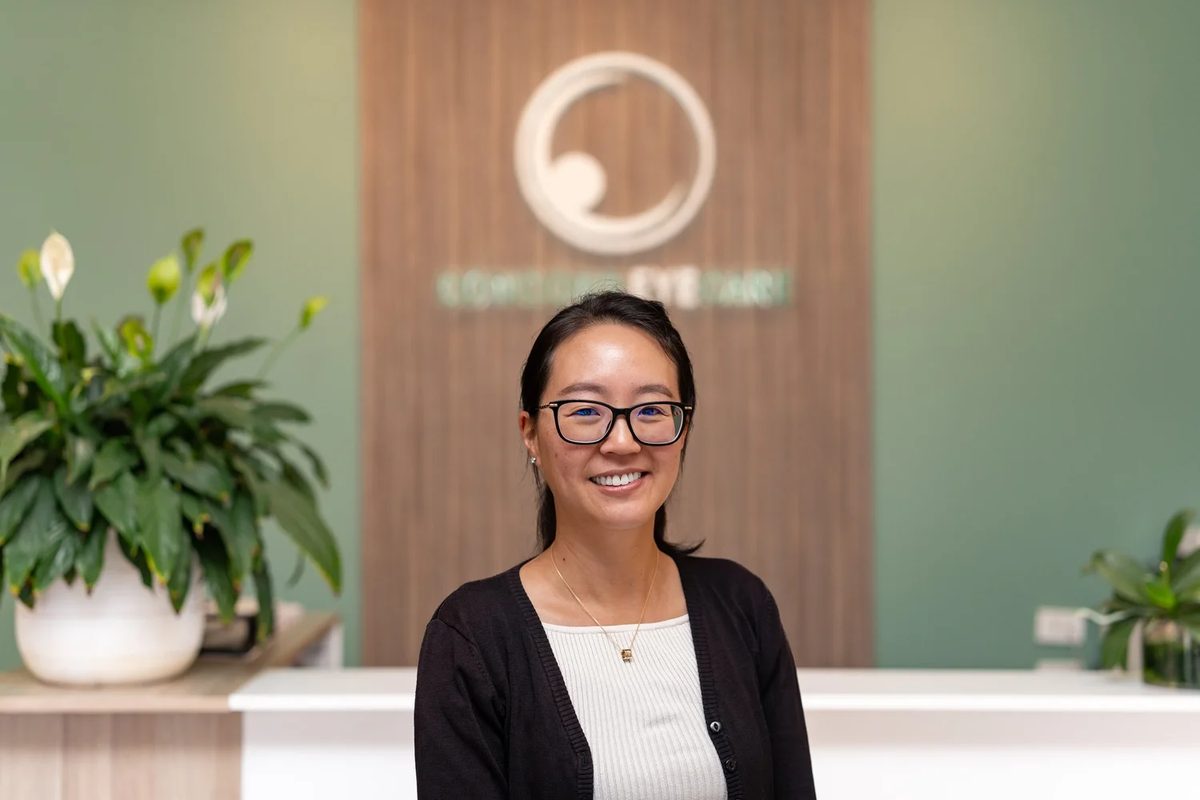

From Dr Nikki, Dr Vivian and Dr Mark
"The children who do best with myopia control are almost always the ones we see within six months of their first myopic prescription. By the time a child has gone from -0.50 to -2.00 over two years, we've missed the window when myopia gets worse fastest. That's the window where intervention changes the long-term outcome most. If your child has just been told they're short-sighted, don't wait for it to 'settle in' before acting."
At each myopia control consultation visit we track refraction, axial length, corneal topography, and binocular function. We compare them against international age-matched growth curves. You'll see the data yourself at every review.
SLOWING MYOPIA AT HOME
Four rules backed by evidence.
1
Two hours outdoors, daily
Natural light is protective. Children who spend 2+ hours a day outdoors have lower rates of developing myopia. Once a child is already short-sighted, outdoor time is still worth it, but the pooled studies do not show it slows their myopia (Xiong et al., 2017). It's the brightness, not the activity — so even the walk to school counts.
2
Two hours screen time, maximum
Leisure screen time (outside of schoolwork) capped at under 2 hours a day for school-aged children. This is the WHO guideline and the one most families find hardest. But closer to 1 hour is better if you can manage it.
3
The elbow rule
Books and screens held no closer than an elbow-to-hand distance from the eyes. Easy test: make a fist, put it next to your eye — your elbow is the minimum reading distance. Closer than that makes myopia get worse faster.
4
The 20/20 rule
Every 20 minutes of near work, take a 20-second break and look across the room. A natural pause between book chapters or Netflix episodes works well. Longer breaks of 5 minutes every hour may be even more effective.
These are the four rules from Myopia Profile — an evidence-based framework developed by Drs Kate and Paul Gifford. None of them replace clinical treatment for a child who's already myopic, but they support every treatment path and they're where we start with every family.
MYOPIA FAQS
The questions parents ask us most often.
What's the difference between myopia and short-sightedness?
They're the same condition. "Short-sightedness" is the everyday Australian term; "myopia" is the clinical one. Both describe an eye where distant vision is blurry and close vision is clear.
Is -1.50 a high prescription for a 7-year-old?
It's moderate, but what matters most is how fast it's changing. A 7-year-old at -1.50 who was -0.50 last year is getting worse quickly and should be assessed for myopia control. A stable -1.50 is less urgent. But it's still worth monitoring with axial length measurements.
Can my child grow out of myopia?
No. Once the eye has elongated, it doesn't shorten back. The change usually slows by the late teens and most people stabilise in their early twenties, but the structural change is permanent. That's why acting early matters.
Do carrots or eye exercises help?
There's no evidence that diet, vitamin supplements, or eye exercises slow myopia. The treatments with strong research support are Ortho-K, MiyoSmart, MiSight, and low-dose atropine. We're happy to show you the evidence for each.
Does screen time cause myopia?
The evidence points more strongly to insufficient outdoor time than to screens specifically. That said, prolonged close-range reading (on any device or on paper) is associated with myopia getting worse faster. Breaks and distance matter more than the screen itself.
How often should my child's eyes be checked?
If your child has been flagged as short-sighted or is at high risk (family history, early onset), we recommend a full review every 6 months. A stable non-myopic child is fine with annual checks. All children should have a first full eye test around age 4.
What's the difference between standard glasses and myopia control glasses?
Standard glasses correct vision but don't slow eye elongation. Myopia control lenses like MiyoSmart use specialised optics to both correct vision and slow myopia, backed by clinical research showing slower axial length progression.
Can myopia still get worse at 16?
Yes, often. In the COMET study about half the children were still getting more short-sighted at 15, and nearly a quarter at 18 (COMET Group, 2013). At 16 we keep measuring eye length every six months and keep treating while the eye is still growing.

Clinically reviewed by Dr Nikki Peng, B.Optom (Hons 1st Class) UNSW, Grad Cert Ocular Therapeutics, ACO Advanced Children's Vision
Last clinically reviewed: April 2026.
The 2,500+ and 1,000+ figures come from our optometrists' practice records across their careers (October 2026).
References (15)
- Holden BA, Fricke TR, Wilson DA, et al. Global Prevalence of Myopia and High Myopia and Temporal Trends from 2000 through 2050. Ophthalmology. 2016;123(5):1036-1042.
- Bullimore MA, Brennan NA. Myopia Control: Why Each Diopter Matters. Optom Vis Sci. 2019;96(6):463-465.
- French AN, Morgan IG, Mitchell P, Rose KA. Risk factors for incident myopia in Australian schoolchildren: the Sydney Adolescent Vascular and Eye Study. Ophthalmology. 2013;120(10):2100-2108.
- Mutti DO, Mitchell GL, Moeschberger ML, et al. Parental myopia, near work, school achievement, and children's refractive error. Invest Ophthalmol Vis Sci. 2002;43(12):3633-3640.
- Lee SS, Lingham G, Sanfilippo PG, et al. Incidence and progression of myopia in early adulthood. JAMA Ophthalmol. 2022;140(2):162-169.
- Chen C, Cheung SW, Cho P. Myopia control using toric orthokeratology (TO-SEE study). Invest Ophthalmol Vis Sci. 2013;54(10):6510-6517.
- Lam CSY, Tang WC, Tse DY-Y, et al. Defocus Incorporated Multiple Segments (DIMS) spectacle lenses slow myopia progression: a 2-year randomised clinical trial. Br J Ophthalmol. 2020;104(3):363-368.
- Chamberlain P, Peixoto-de-Matos SC, Logan NS, et al. A 3-year randomized clinical trial of MiSight lenses for myopia control. Optom Vis Sci. 2019;96(8):556-567.
- Yam JC, Li FF, Zhang X, et al. Two-Year Clinical Trial of the Low-Concentration Atropine for Myopia Progression (LAMP) Study. Ophthalmology. 2020;127(7):910-919.
- Haarman AEG, Enthoven CA, Tideman JWL, et al. The Complications of Myopia: A Review and Meta-Analysis. Invest Ophthalmol Vis Sci. 2020;61(4):49.
- World Health Organization. Guidelines on Physical Activity, Sedentary Behaviour and Sleep for Children Under 5 Years of Age. 2019.
- Brennan NA, Toubouti YM, Cheng X, Bullimore MA. Efficacy in myopia control. Prog Retin Eye Res. 2021;83:100923.
- Gifford KL, Richdale K, Kang P, et al. IMI – Clinical Management Guidelines Report. Invest Ophthalmol Vis Sci. 2019;60(3):M184-M203.
- Xiong S, Sankaridurg P, Naduvilath T, et al. Time spent in outdoor activities in relation to myopia prevention and control: a meta-analysis and systematic review. Acta Ophthalmol. 2017;95(6):551-566.
- COMET Group. Myopia stabilization and associated factors among participants in the Correction of Myopia Evaluation Trial (COMET). Invest Ophthalmol Vis Sci. 2013;54(13):7871-7884.