
Eikance · low-dose atropine
Eikance eye drops for myopia control
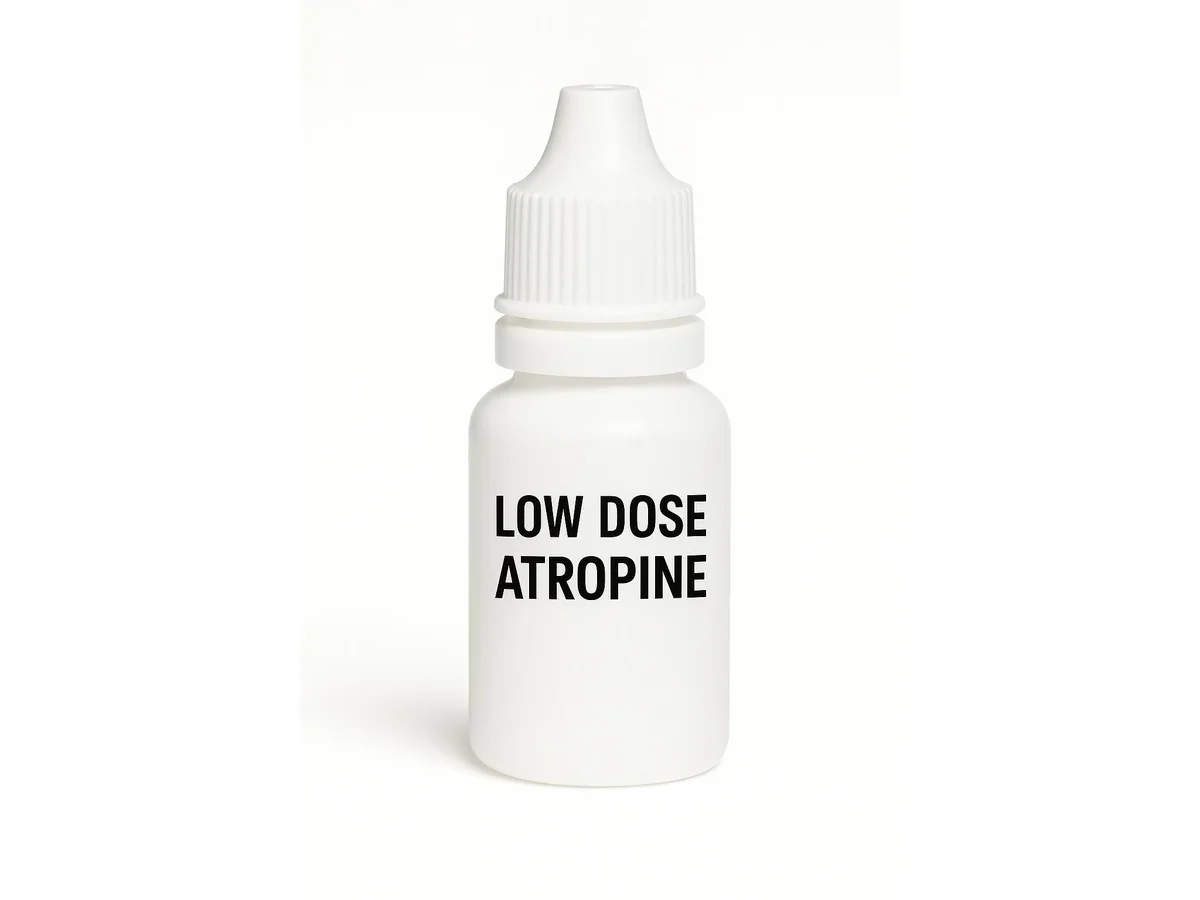
Eikance is low-dose atropine: a bedtime eye drop that slows childhood myopia.
We prescribe all three strengths.
- ★ 4.9 from 200+ Google reviews
- Advanced qualifications in children's vision All of our optometrists hold advanced qualifications in children's vision
- 2,500+ children cared for by our optometrists
- 1,000+ ortho-K lenses fitted between our optometrists
Eikance eye drops
What is Eikance?
A TGA-registered low-dose atropine eye drop in single-dose ampoules without preservatives.
3
Strengths
0.01%, 0.025% and 0.05% (Aspen Pharmacare; TGA ARTG).
1 drop
At bedtime
Low-dose atropine reduces the signal driving fast axial length progression.
100+ yrs
In eye care
These low doses work very differently from strong examination drops.
Suitability
Who is low-dose atropine for?
Children whose short-sightedness worsens year on year.
We usually recommend it for children meeting these practice criteria.
Not for children with angle-closure glaucoma or a family history of it, a known atropine allergy, or no way to receive a drop reliably each evening.
Strength
Which strength will my child need?
All three strengths are Eikance; we choose according to how quickly myopia changes.
When we use it
0.01%
With ortho-K or myopia control glasses doing the main work
0.025%
Alone for mild to moderate progression
0.05%
Alone for faster progression
What to expect
0.01%
Most children notice little
0.025%
Some light sensitivity and slight pupil widening
0.05%
Light sensitivity and near blur more likely initially
Effect by strength: LAMP study, Yam et al., 2019. We review every six months and adjust strength if progression changes.
If Eikance does not suit your child, we can prescribe compounded atropine from a compounding pharmacy instead.
Is your child's myopia getting worse? Find out at the assessment.
The evidence
Does a stronger drop work better?
Yes: in year one of the LAMP study, 0.05% slowed prescription change more than twice as much as 0.01%.
Each strength was compared with placebo drops (Yam et al., 2019). Higher strengths cause slightly more light sensitivity and pupil widening; most children tolerate them well.
Longer follow-up questions how much 0.01% achieves alone, so we pair it with ortho-K or myopia control glasses and use 0.025% or 0.05% when atropine works alone.
Why strength matters
How do we choose the strength?
The strength is a clinical decision, made from three things we measure and discuss.
Speed
How fast the eyes are getting worse.
Alone or combined
0.01% with a lens; 0.025% or 0.05% when drops work alone.
Response
How the eyes respond at each six-monthly review.
In the LAMP study, stronger drops slowed myopia more and caused more light sensitivity (Yam et al., 2019).
Eikance or compounded
Registered or compounded atropine, which do we use first?
Pharmacy rules favour a registered medicine when one exists at the strength needed.
How it is made
Eikance
To one registered standard
Compounded atropine
Made to order
Strengths
Eikance
0.01%, 0.025% and 0.05%
Compounded atropine
Made to the prescribed strength
When we use it
Eikance
When a registered strength suits your child
Compounded atropine
When Eikance does not suit a child
Source: Pharmacy Board of Australia compounding guidelines (2024).
How we prescribe
How do we prescribe Eikance?
All three of our optometrists are therapeutically endorsed, so treatment can start after the assessment.
Visit 1
Myopia assessment
Full examination, refraction and eye length on our ZEISS IOLMaster 500.
Same visit
Prescription
Whether atropine suits, which strength, and any ortho-K or glasses.
Days after
Filling the script
Eikance from a pharmacy, or compounded atropine if needed.
Every 6 months
Review
Eye length and prescription; we adjust strength if progression changes.
We have no financial relationship with any pharmacy; our recommendation is clinical.
Side effects
What are the side effects?
Most children notice little; light sensitivity and slight near blur are more common at higher strengths.
The first week
In our experience most parents report little after the first week. Near blur usually settles as the eye adjusts.
Bright light
Photochromic glasses (lenses that darken outdoors) help if bright light bothers your child.
Rare effects
Allergic reactions or persistent near blur are rare. Contact us; we can adjust strength or pause treatment.
Using the drops
Tips for using atropine at home
One pupil looks bigger than the other
Usually one eye received more drop that night. This evens out over a few days. Some pupil widening is normal.
Do not stop suddenly
Abrupt stopping can cause rebound, especially at higher strengths (Yam et al., 2022). Talk to us first so we taper; keep a spare supply.
Same time each evening
Bedtime is usual so any blur occurs during sleep. After dinner also works. Consistency matters more than the clock.
Common questions
Eikance questions
What parents most often ask us
Can an optometrist prescribe Eikance?
Yes. Therapeutically endorsed optometrists can prescribe Eikance and compounded atropine. All three of ours are endorsed.
Is Eikance 0.025% available in Australia?
Yes. Eikance comes in 0.01%, 0.025% and 0.05% (TGA ARTG 408371 for 0.025%). We prescribe all three.
Is Eikance on the PBS?
No. No strength of Eikance has a PBS subsidy, so it is filled as a private prescription.
What's the difference between Eikance and compounded atropine?
Both contain the same active ingredient. Eikance is TGA-registered and made to one standard in single-dose ampoules. Compounding pharmacies make atropine to order; we use it when Eikance does not suit a child. Compounded atropine
How long will my child need to use atropine?
Usually until myopia settles, often in the late teens. We review every six months and taper when measurements support it.
Can Eikance be used with Ortho-K or MiyoSmart?
Does Eikance hurt or sting?
No. One drop per eye at bedtime, without preservatives. Most children barely notice it.

Reviewed by Dr Mark Joung · Last updated 11 May 2026
B.Optom (Hons) UNSW · Certificate in Ocular Therapeutics (ACO) · Advanced Paediatric Eye Care · AHPRA OPT0001052897
Mark is the principal optometrist at Concord Eyecare and prescribes Eikance and compounded atropine in all three strengths.
The 2,500+ and 1,000+ figures come from our optometrists' practice records across their careers (October 2026).
References (5)
- Yam JC, Jiang Y, Tang SM, et al. Low-Concentration Atropine for Myopia Progression (LAMP) Study: a randomized, double-blinded, placebo-controlled trial of 0.05%, 0.025%, and 0.01% atropine eye drops in myopia control. Ophthalmology. 2019;126(1):113-124.
- Yam JC, Zhang XJ, Zhang Y, et al. Three-Year Clinical Trial of Low-Concentration Atropine for Myopia Progression (LAMP) Study: Continued Versus Washout. Ophthalmology. 2022;129(3):308-321.
- Chia A, Chua WH, Cheung YB, et al. Atropine for the treatment of childhood myopia: safety and efficacy of 0.5%, 0.1%, and 0.01% doses (ATOM2). Ophthalmology. 2012;119(2):347-354.
- Aspen Pharmacare Australia. EIKANCE Product Information (0.01%, 0.025%, 0.05%). Therapeutic Goods Administration ARTG; 0.025% entry 408371.
- Pharmacy Board of Australia. Guidelines on Compounding of Medicines. August 2024.
Find out how your child's eyes are changing
Appointments Monday to Saturday with a therapeutically endorsed optometrist.